agent-sphere
English | Chinese









4A = Business Architecture / Application Architecture / Technology Architecture / Data Architecture
Contents
- 0. One-Line Positioning
- Product Preview
- 1. Business Architecture
- 2. Application Architecture
- 3. Technology Architecture
- 4. Data Architecture
- 5. 4A Traceability Matrix
- 6. Quick Start
- 7. Repository Map
- 8. Development & Verification
0. One-Line Positioning
Package LLM + tools + browser + memory + model routing into a configurable Agent instance, and expose it through conversational, task-oriented and capability-based entry points.
AgentSphere is an agent hosting platform, not a single agent. The instance is the configuration unit, capabilities are the supply unit, and models are the routing unit. All three are decoupled.
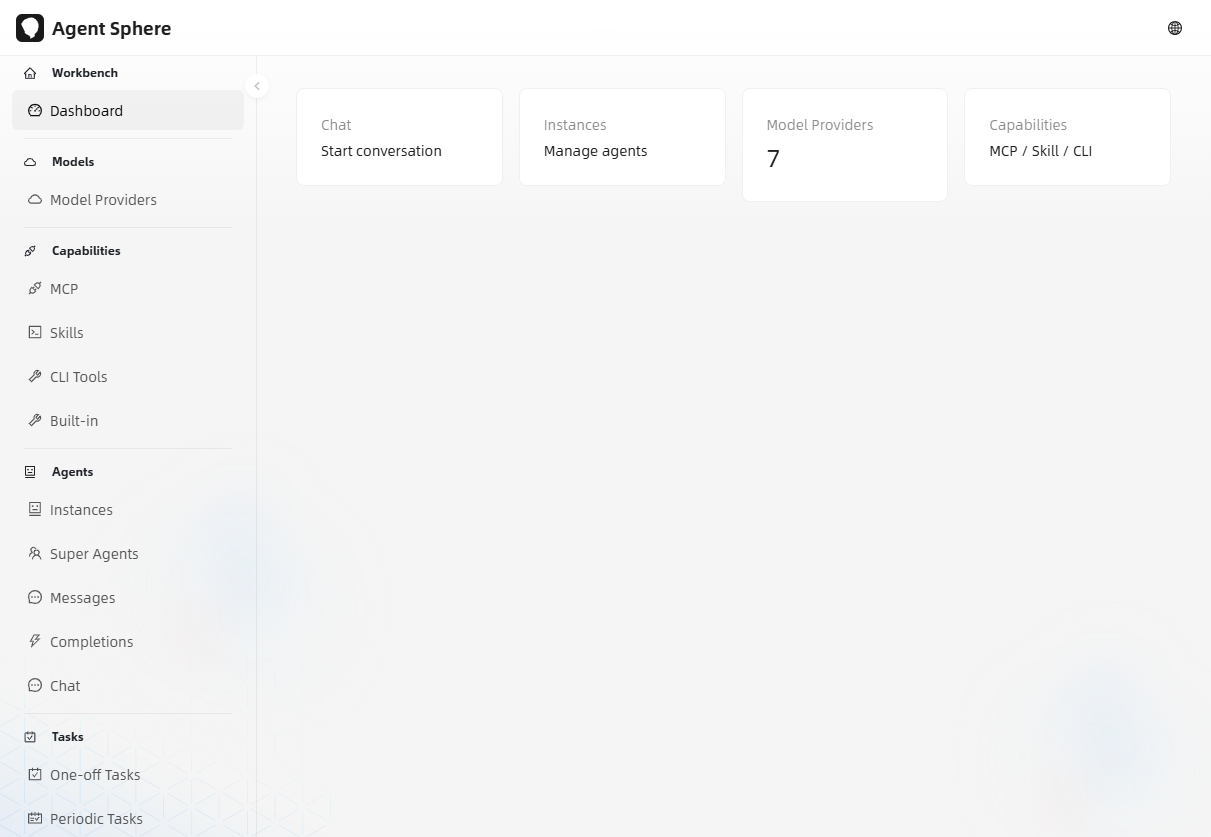
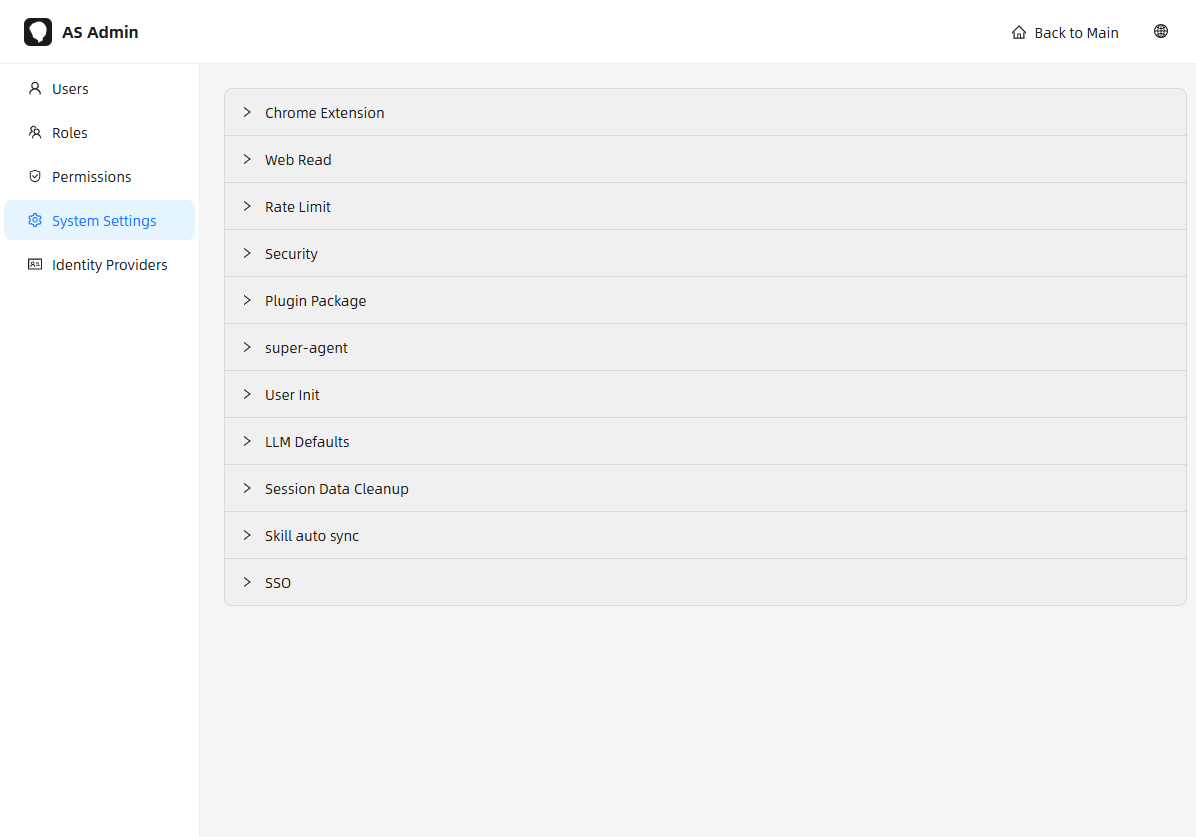
Product Preview
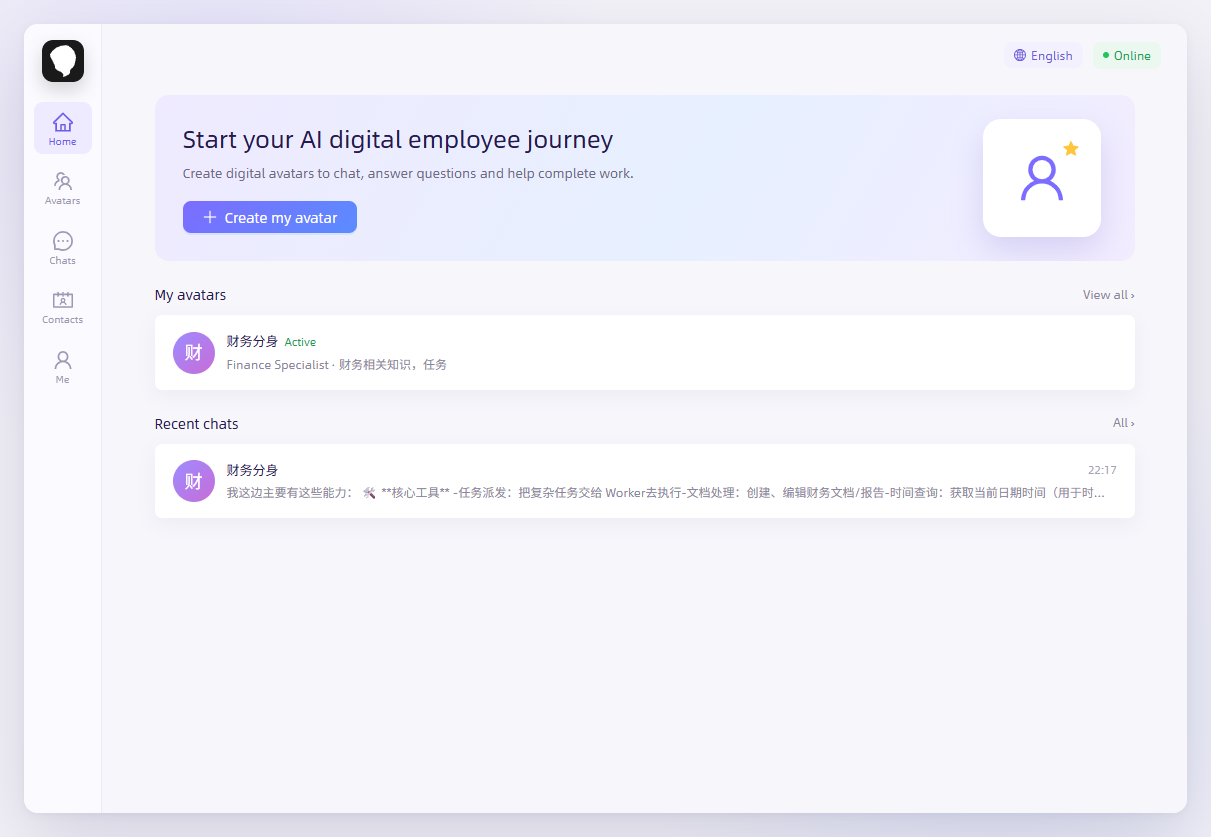
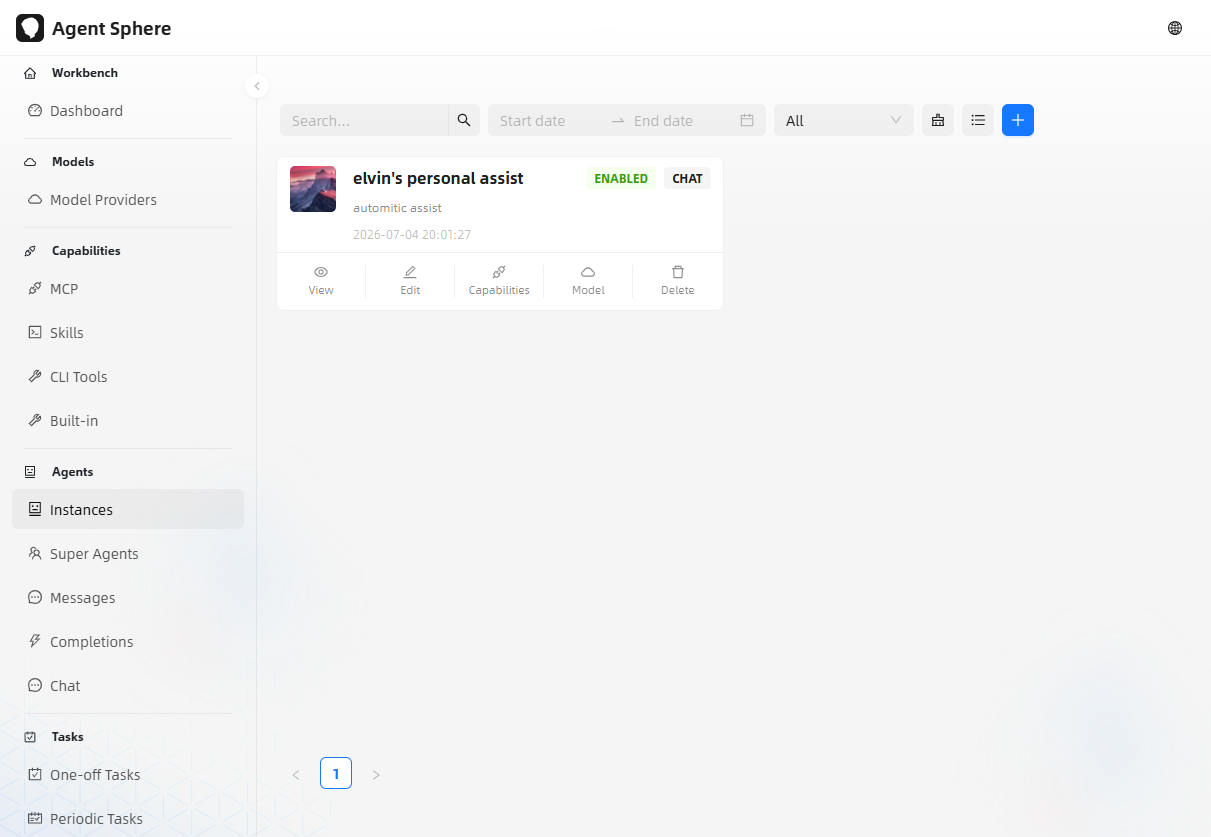
Live screenshots from the deployed product. The Chinese versions of the same screens are used by README.zh-CN.md.
| Agent operations | System administration | Super Agent workspace |
|---|---|---|
 |
 |
 |
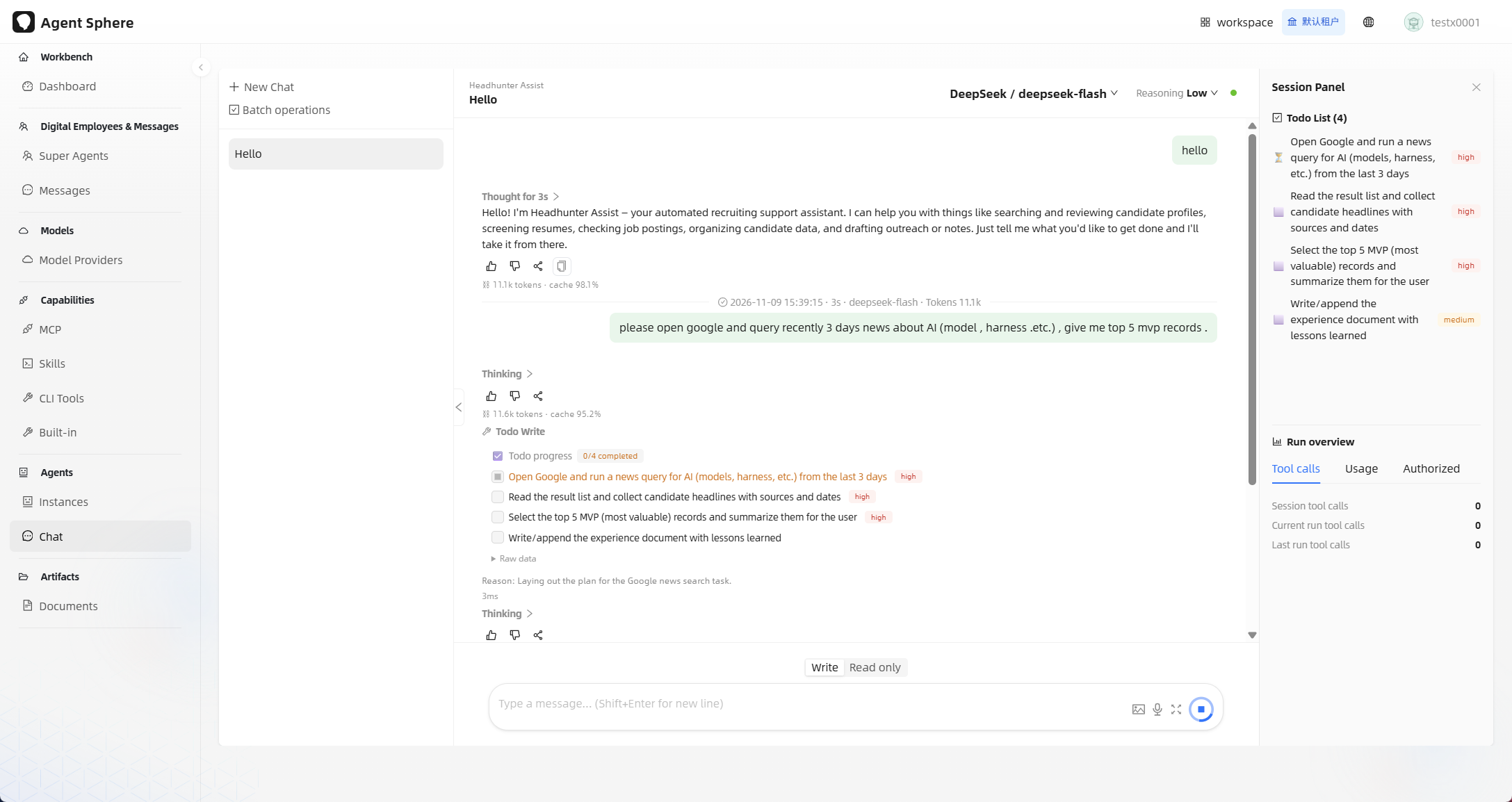
Agent configuration and conversation
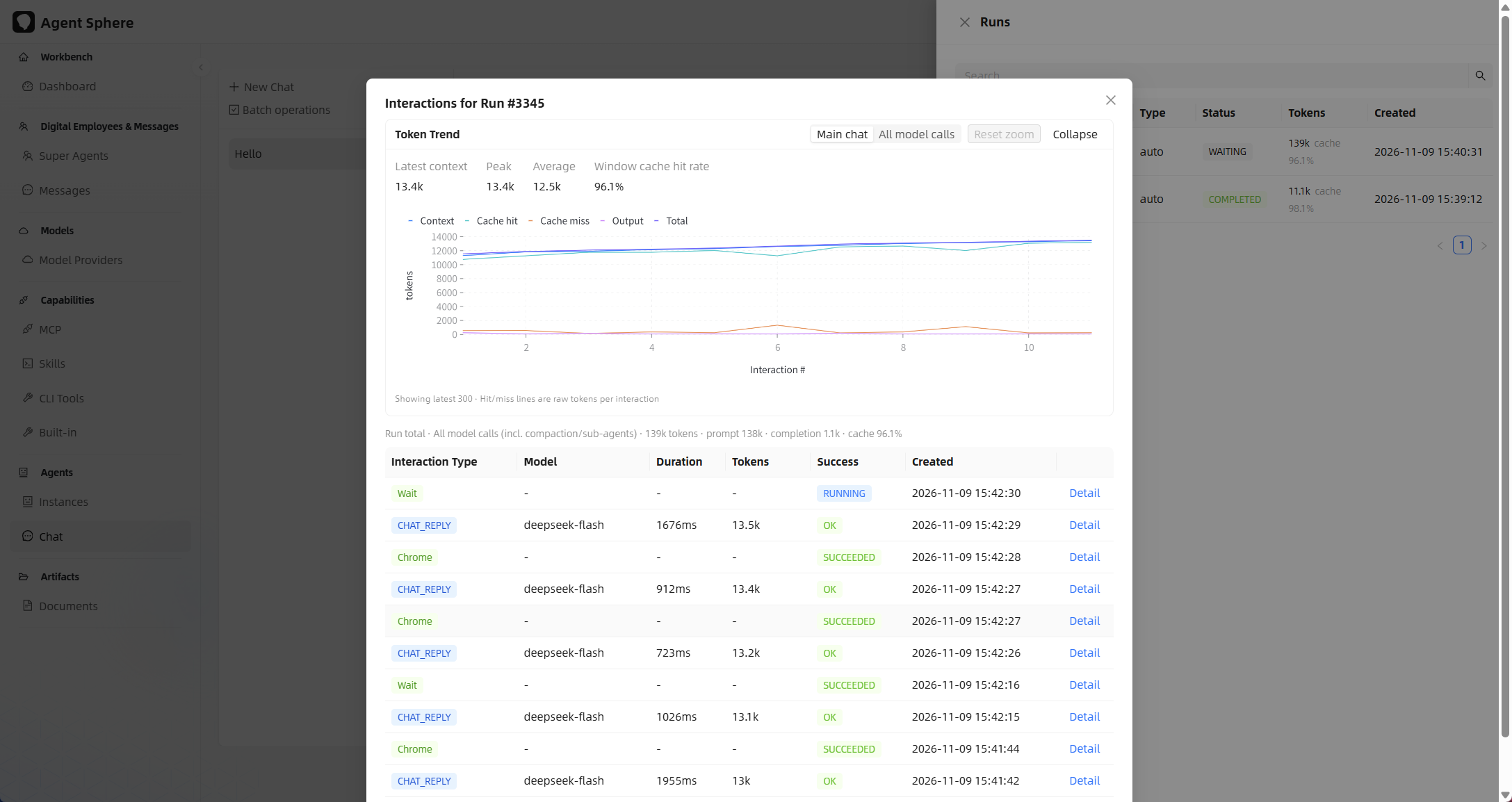
| Instances | Chat | Session observability |
|---|---|---|
 |
 |
 |
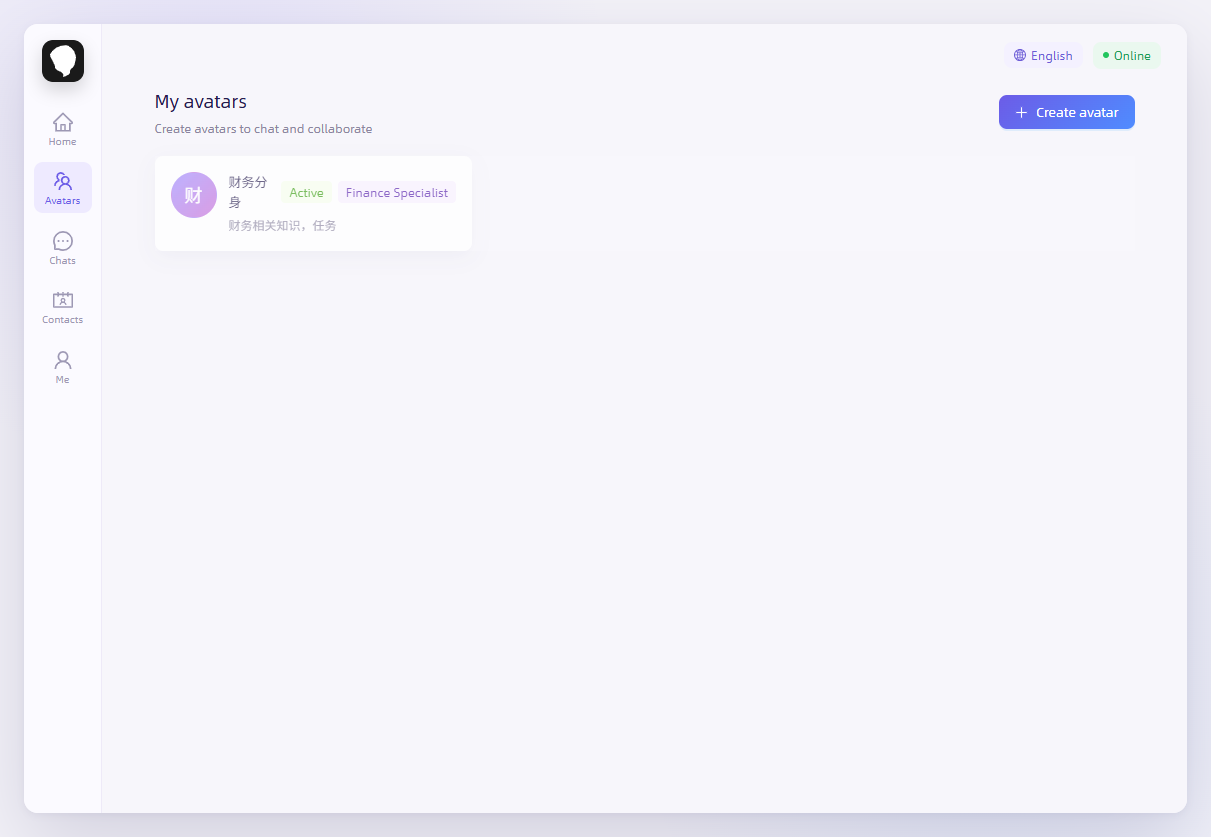
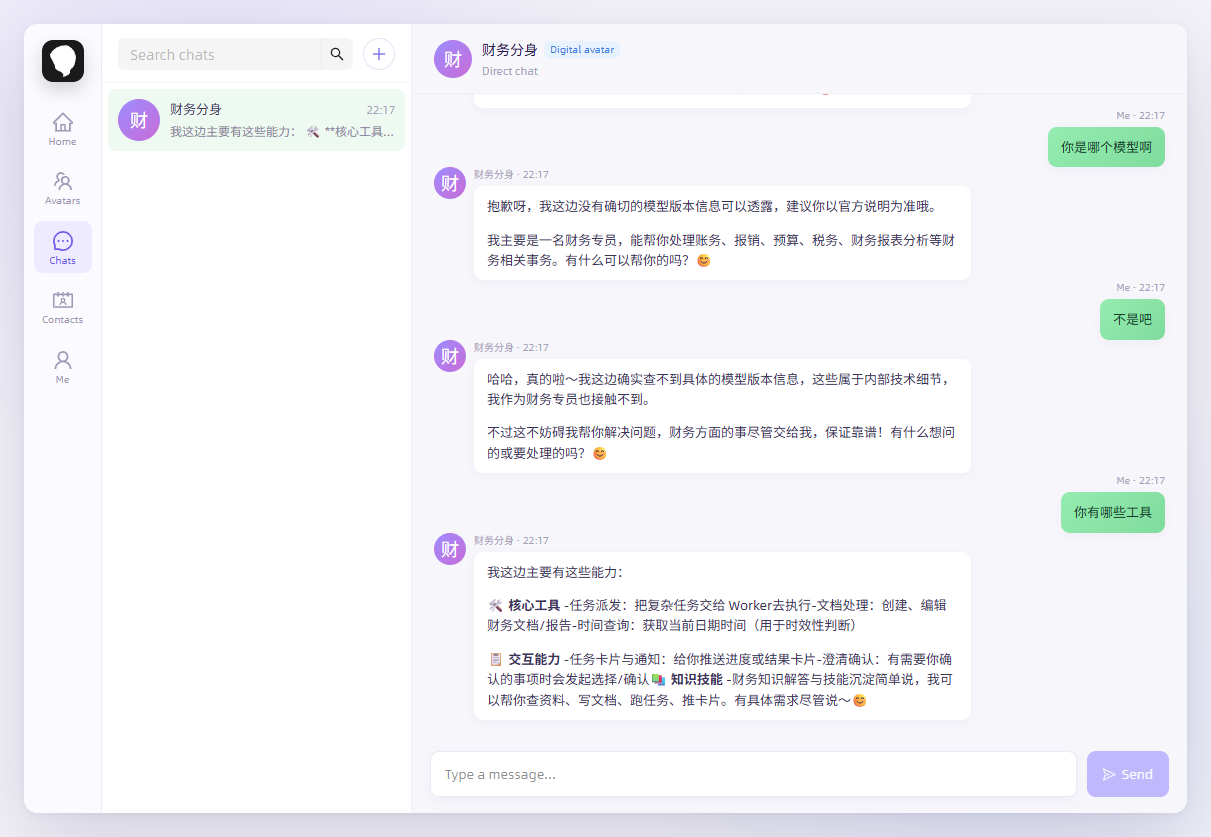
Digital employees and IM
Screenshots from the Super Agent product at /workspace.
| Digital employees | Digital employee chats |
|---|---|
 |
 |
1. Business Architecture
1.1 Positioning
| Dimension | Content |
|---|---|
| Served parties | Platform admins / operator-developers / end users / external business systems / digital-employee users |
| Core value | Let business teams get a working agent without writing code: it looks things up, calls APIs, drives web pages and returns structured results |
| Delivery shapes | Conversational (console / widget) · Task-based (submit + callback) · Capability-based (one-shot completion) · Digital employee (/workspace) |
| Differentiation | Instance-level configuration, real browser operation, installable skills, multi-provider failover, Super Agent routing and IM channels |
Product surfaces
| Entry | Product | Main capabilities |
|---|---|---|
http://127.0.0.1:8000/** |
Agent operations platform (excluding /admin/** and /workspace) |
Agent instances, capability center, model routes, chat, tasks, artifacts, IM operations, Super Agent configuration |
http://127.0.0.1:8000/admin/** |
System administration | Users, roles, permissions, identity providers, dictionaries, system config, audit logs |
http://127.0.0.1:8000/workspace |
Super Agent product | Digital-employee list, conversations, contacts, task collaboration, replies |
/**is the admin/operator view./admin/**is platform governance./workspaceis the end-user product for digital employees.
1.2 Actors and Roles
| Role | Primary entry | Focus |
|---|---|---|
| Platform admin | /admin/** |
Users, roles, permissions, identity providers, audit, system config |
| Operator / developer | Web console | Configure instances, wire MCP, author skills, tune model routes |
| End user | /chat, embedded widget |
Ask, answer clarifications, watch execution |
| Digital-employee user | /workspace |
Talk to Super Agents, follow work items, receive replies |
| External business system | /api/v1/api/* |
Submit tasks, fetch artifacts, run one-shot completions |
| IM / channel user | IM, webhook, embedded channel | Send messages to a digital employee; receive routed replies |
| Headless browser | Chrome extension | Operate real web pages under agent control |
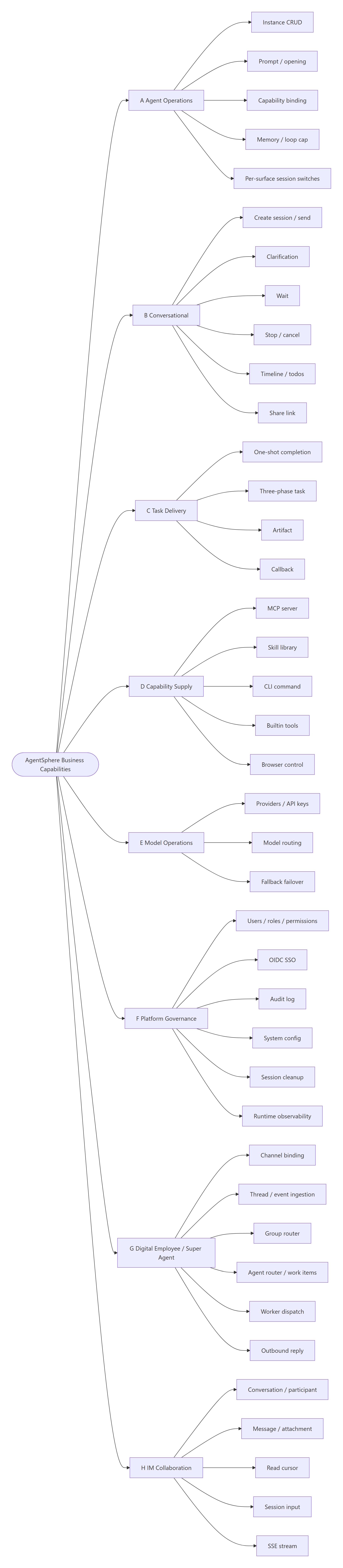
1.3 Business Capability Map
1.4 Core Business Flows
Conversational path (human in the loop)

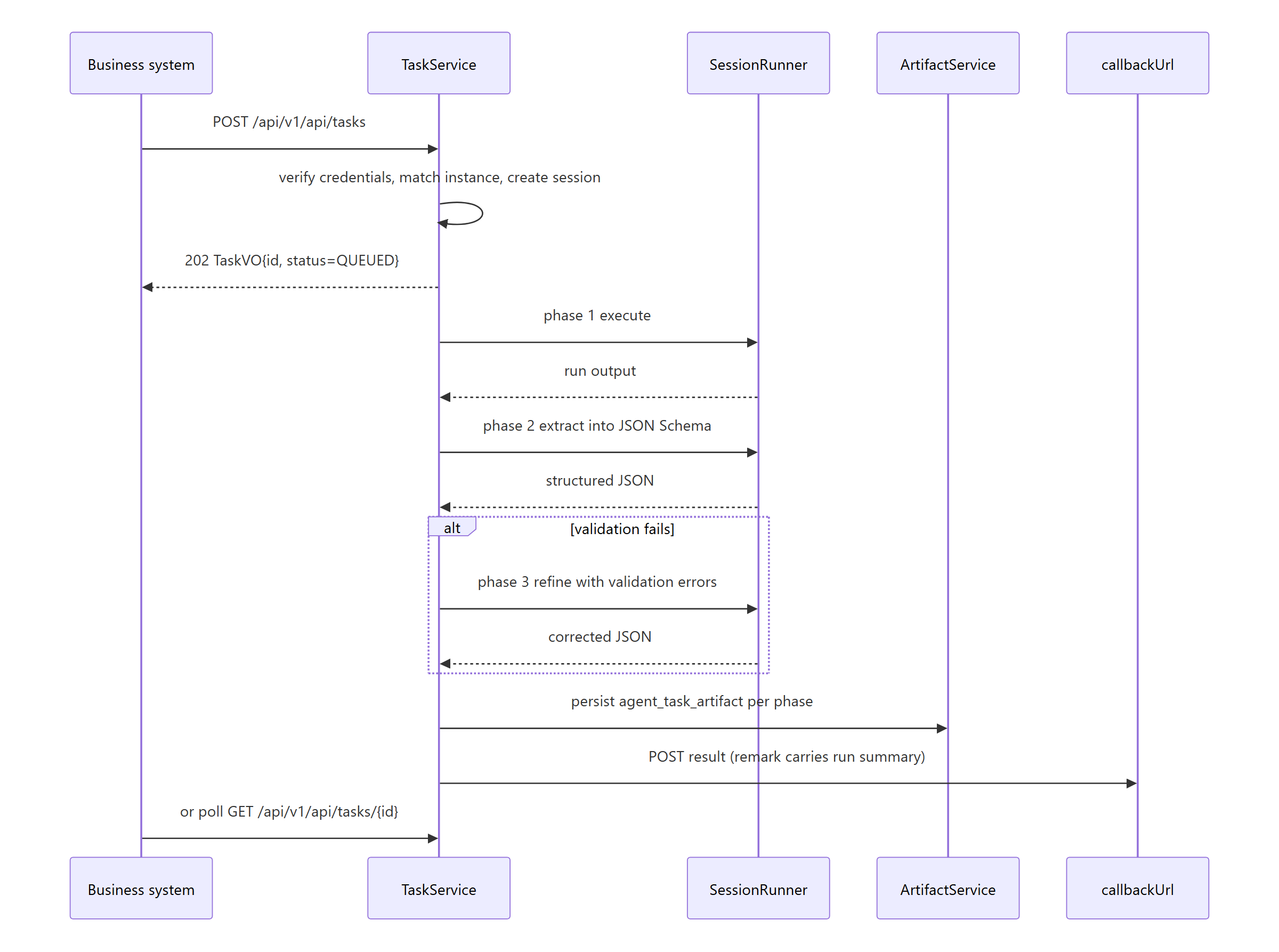
Task path (system to system, three phases)
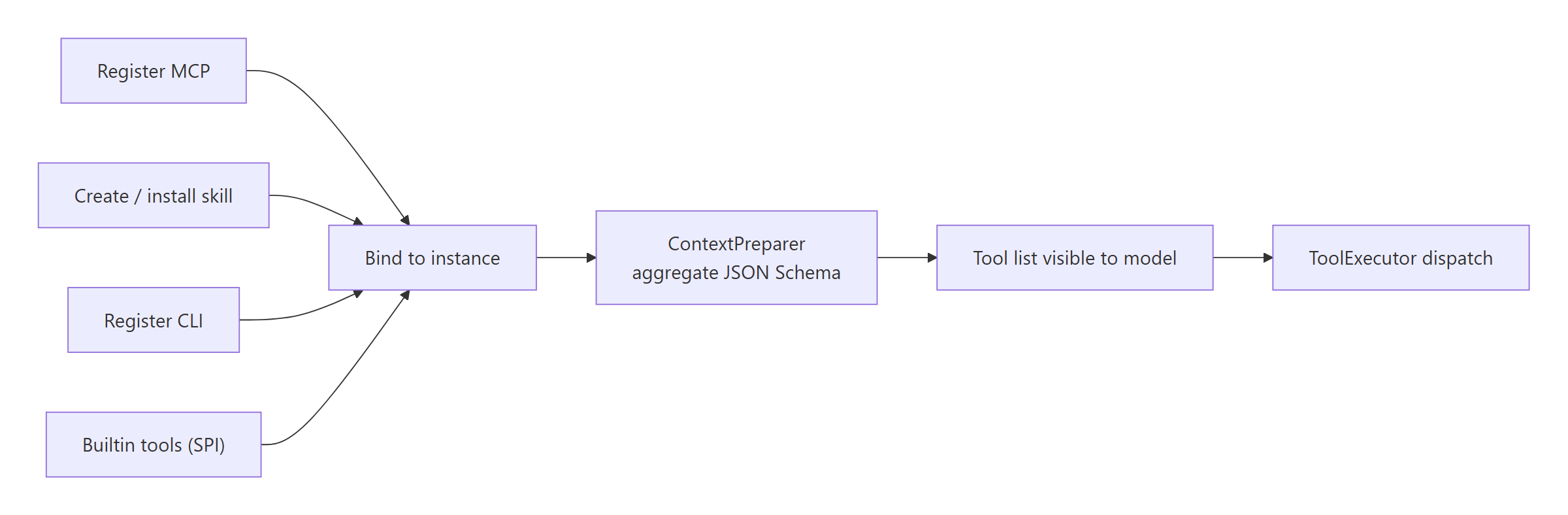
Capability path (supply → consumption)
Super Agent path (digital employee)
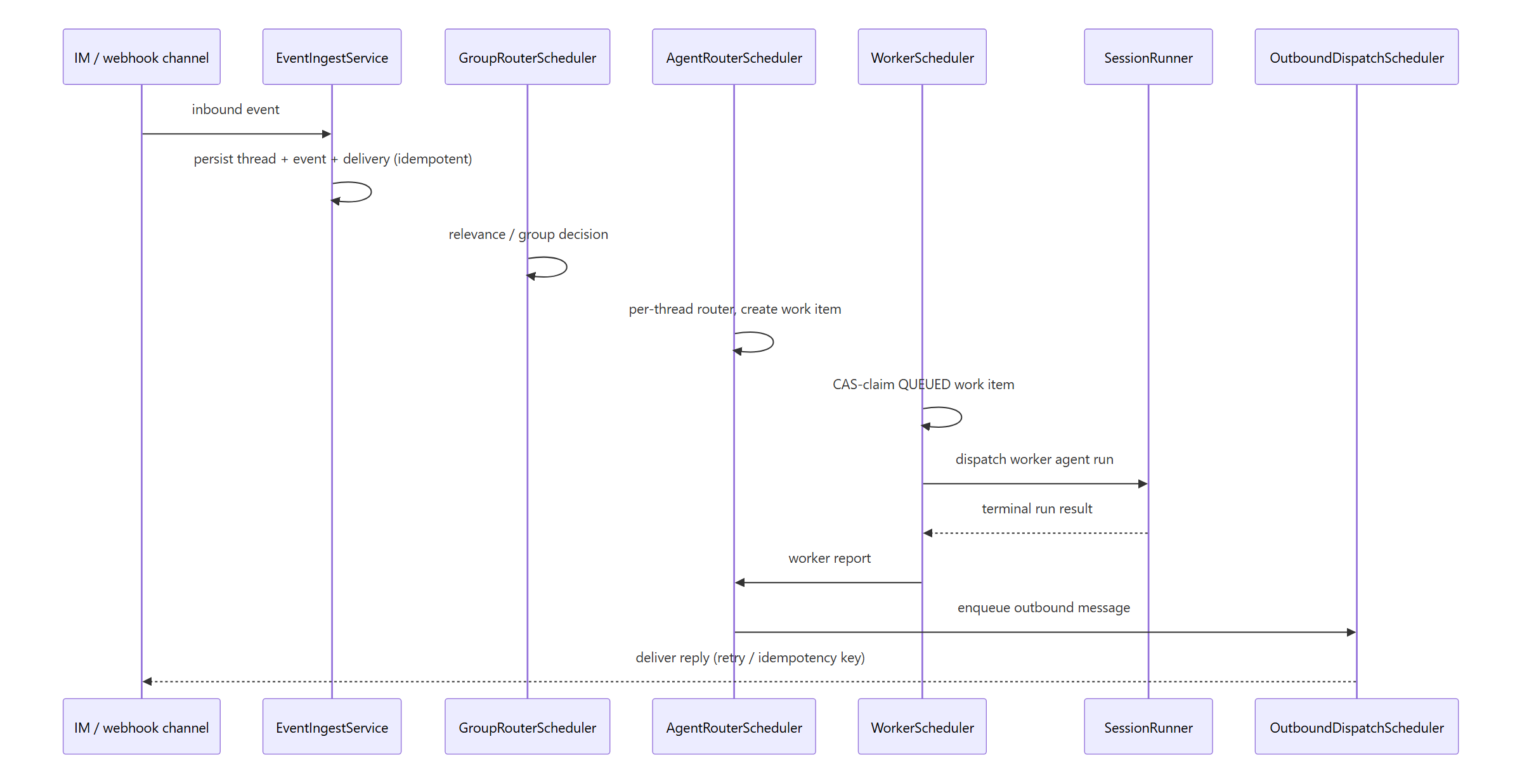
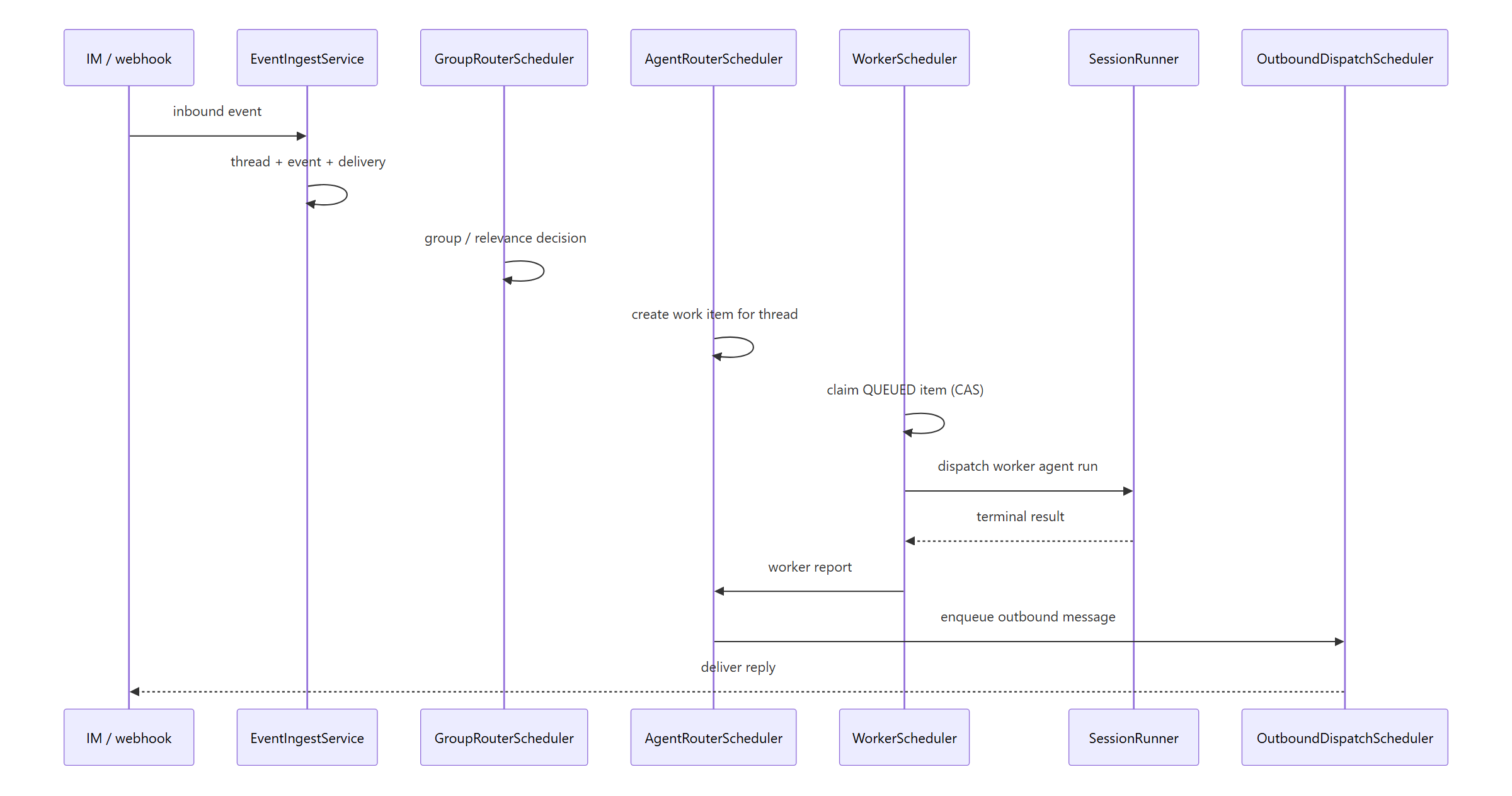
A Super Agent is a digital employee composed of a Router instance + Worker instance + channel bindings. Inbound events become threads/work items; worker runs produce reports; outbound messages are delivered back to the originating channel.
IM collaboration path

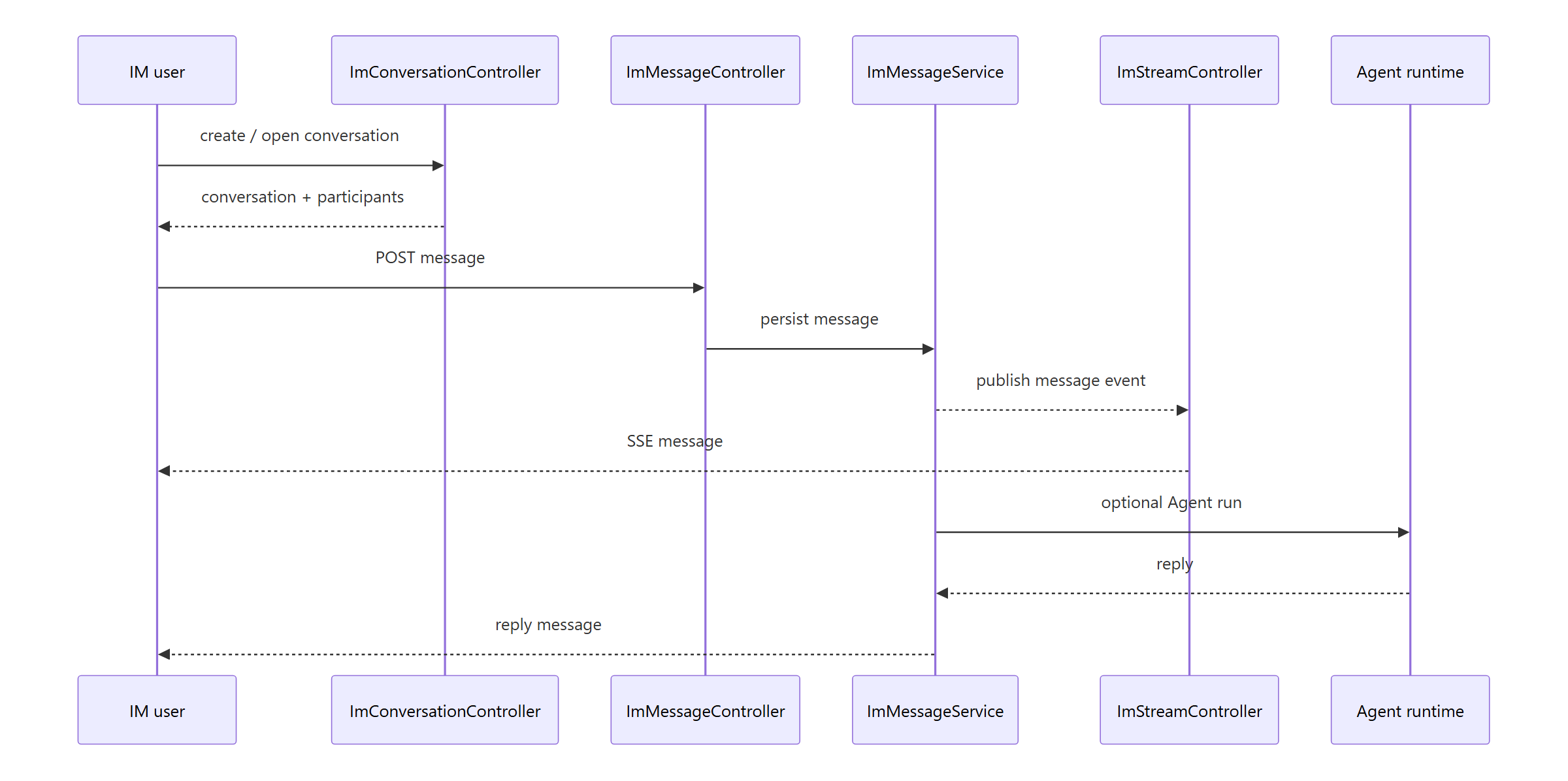
IM is a channel for both human-to-human and human-to-agent collaboration. Conversations, participants, messages, attachments and read cursors are independent from Agent timelines; a message can trigger an Agent run and the reply is written back as an IM message.
1.5 Business Rules
| Rule | Why |
|---|---|
Sessions are gated per entry point: allow_console_session / allow_widget_session (widget default false) |
Console and widget share one API and token; only X-Client-Surface distinguishes them. INTERNAL must stay allowed for tasks |
Skill body must follow # H1 + ## stepN + ### stepN.M |
Step numbers anchor todo-to-skill lookup; broken format breaks per-step retrieval |
Skill marketplace only shows visibility=PUBLIC AND created_by IS NOT NULL |
Row-level permission filters by created_by; the marketplace opens up explicitly |
Task timeout = max(caller value, server floor) |
Most production tasks hard-code 3600s; only a server floor can raise them |
finish is the only legal close-out for agentic runs and is not exposed to pure-chat instances |
Otherwise a few sentences can fake delivery and fail silently |
| The “no more tools” hint is injected only near the final turn | Banning tools early truncates work into a half-finished product |
| A Super Agent always owns exactly one Router instance and one Worker instance, plus channel bindings | The router decides relevance/ownership; the worker executes. Keeping the roles separate prevents one prompt from doing both |
| Inbound channel events are persisted before routing; deliveries and outbound messages are idempotent | Webhook retries and reconnect bursts must not create duplicate work items or duplicate replies |
| Worker work items are claimed with a CAS status transition; only the worker report writes terminal state | Two replicas must never dispatch the same item, and scheduler retries must not overwrite a finished result |
| Outbound replies use persist-then-send with retry and an idempotency key | Channel delivery can fail; the outbox is the source of truth |
| IM messages and Agent sessions are linked by conversation/session ids, not by a shared timeline table | IM history and Agent execution history have different retention and read patterns |
1.6 Scope Boundaries (Non-Goals)
- Not a general workflow orchestrator: orchestration lives inside a single agent’s ReAct loop, not a visual DAG designer.
- No model training / fine-tuning: inference-side routing and adaptation only.
- No SaaS billing/quota:
tenant_idis reserved, but no billing module exists. - Scheduled tasks not shipped:
/periodic-tasksremains a placeholder.
2. Application Architecture
2.1 Application Landscape
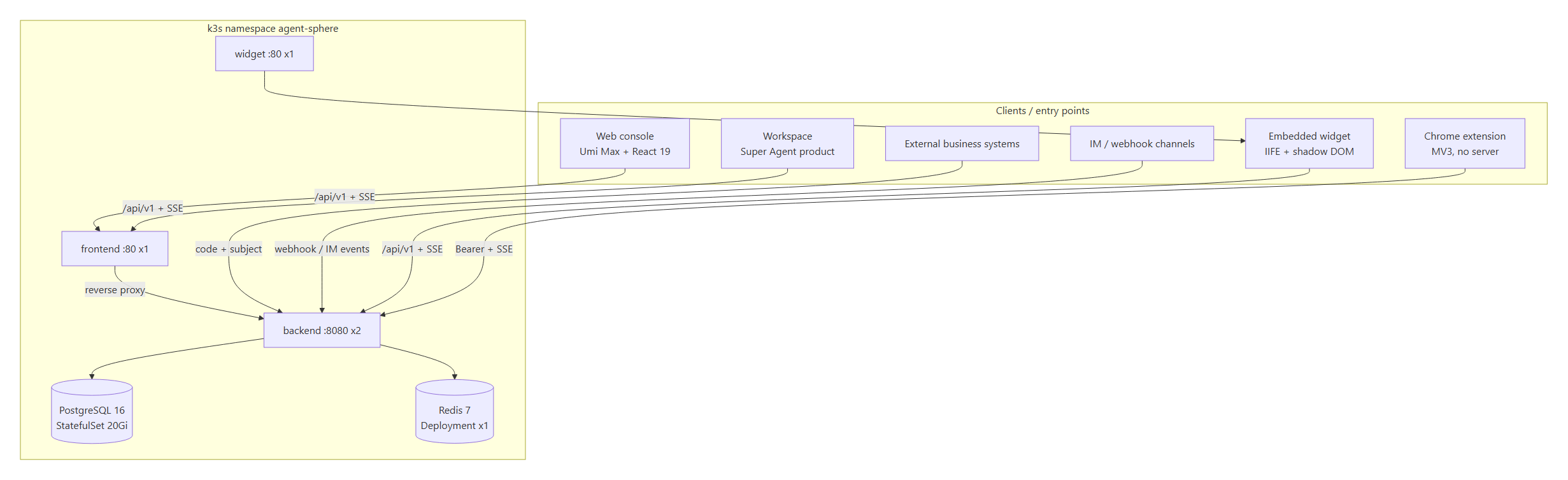
2.2 Backend Modules and Dependencies
Business domains use the same layered split:
-domain → -exception → -dtvo → -spi → -repository → -service → -controller
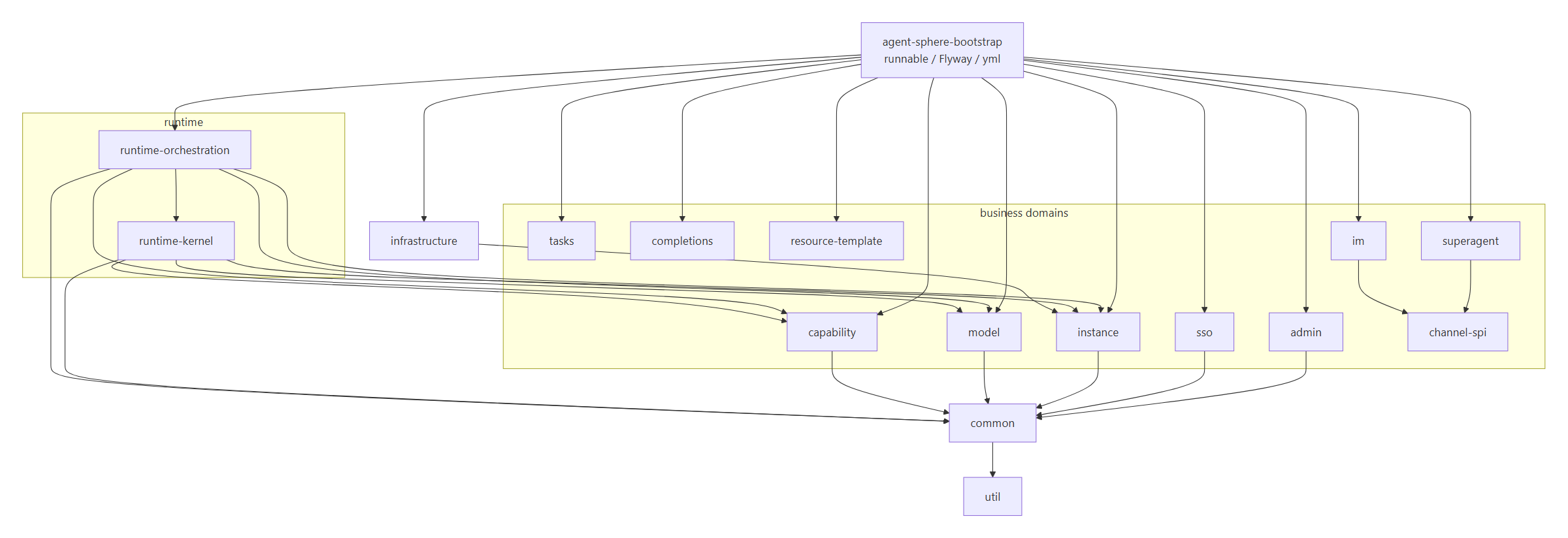
Dependency discipline:
controller → service → repository → spi → domain; controllers depend on*-spi, never implementations.- The kernel must not depend back on orchestration; use Spring local events for cross-layer actions.
infrastructuredepends oninstance-service, so instance must not depend back on infrastructure.
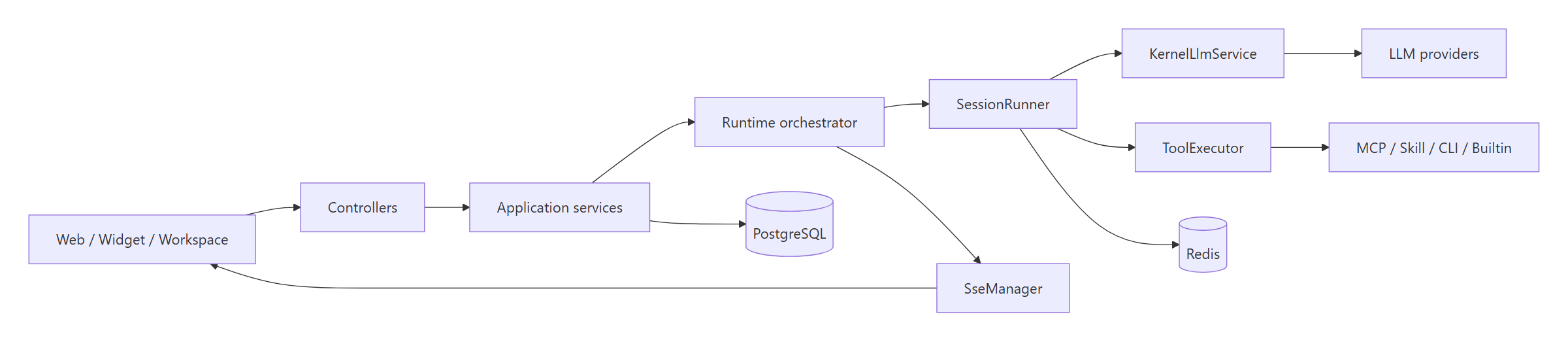
2.3 Call Graphs
Static component relationships
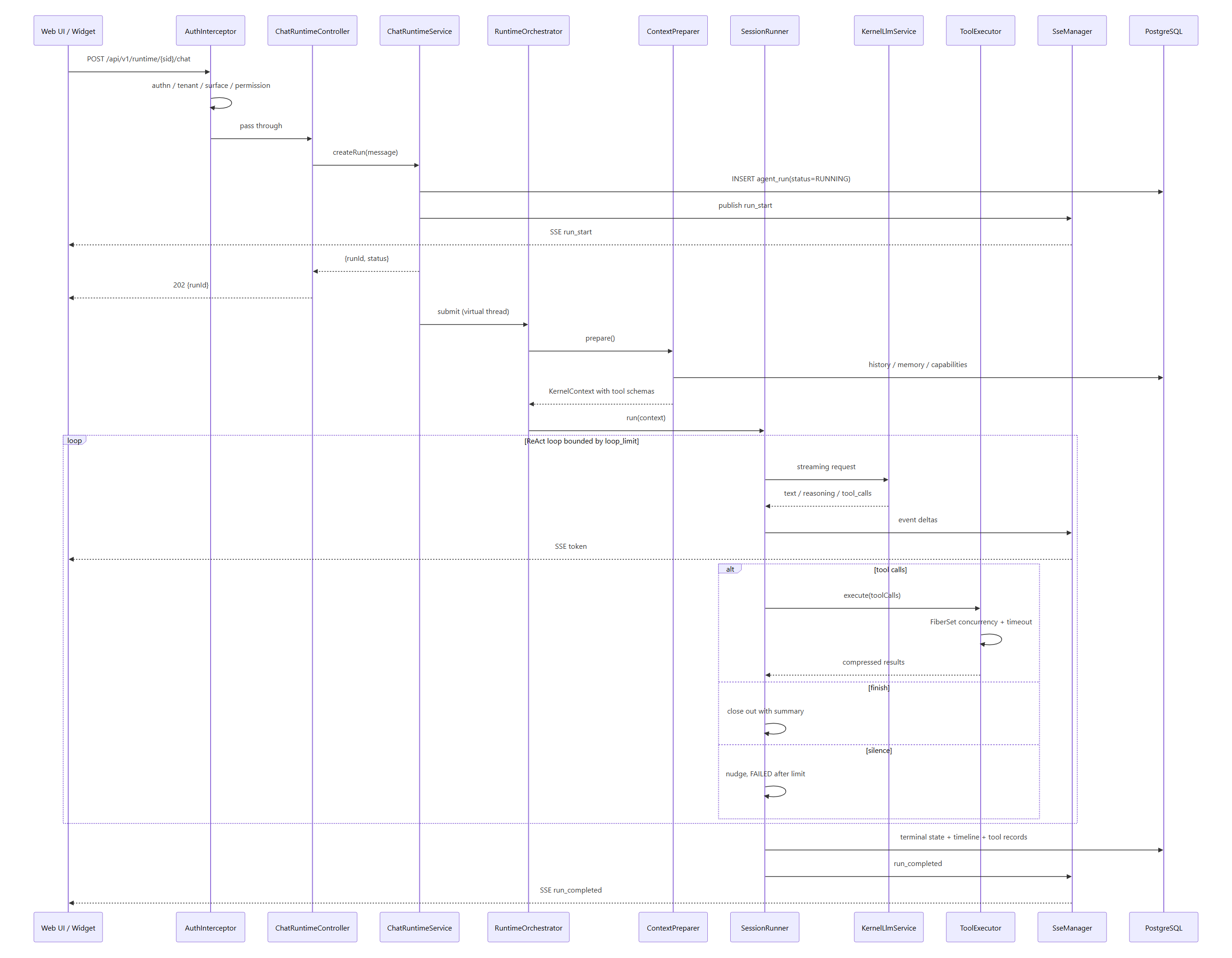
One chat call sequence
Super Agent digital-employee sequence
IM message sequence
2.4 Integration Matrix
| Direction | Counterparty | Protocol / credentials |
|---|---|---|
| Inbound | Web console / widget / workspace / extension | REST + SSE (/stream), Bearer token |
| Inbound | External business systems | code + subject + businessType, no Bearer |
| Inbound | Chrome extension | Long-lived /runtime/user/task/stream + /api/v1/chrome callbacks |
| Inbound | IM / webhook channels | Normalized events through EventIngestPort; channel bindings |
| Outbound | Channel adapter | IM / webhook replies from the outbound outbox |
| Outbound | LLM providers | OpenAI-compatible streaming + vendor strategy |
| Outbound | MCP server | Model Context Protocol (Streamable HTTP) |
| Outbound | Identity provider | OIDC authorization code + PKCE + nonce + JWKS |
| Outbound | Business callback | callbackUrl POST |
3. Technology Architecture
3.1 Technology Stack
| Layer | Choice |
|---|---|
| Language / runtime | Java 21, Spring Boot 3.4.3, virtual threads |
| Persistence | PostgreSQL 16, MyBatis-Plus 3.5.9, Flyway (149 migrations) |
| Coordination | Redis 7 + Redisson 3.40.2; Spring Data Redis forbidden |
| Resilience / cache | Resilience4j, Caffeine |
| Tools / schema | MCP, victools, swagger-core, Hutool |
| Super Agent / channels | Channel SPI adapters, event/outbox schedulers, Redisson locks |
| Realtime | SSE with per-session emitters, heartbeat and event-cache catch-up |
| Frontend | React 19, UmiJS Max, Ant Design 6, Biome |
| Widget | Vite library mode, IIFE, shadow DOM |
| Extension | Manifest V3, native ESM, chrome.debugger only in cdp-client.js |
| Deployment | k3s, Ingress, Fleet GitOps |
3.2 Deployment Topology
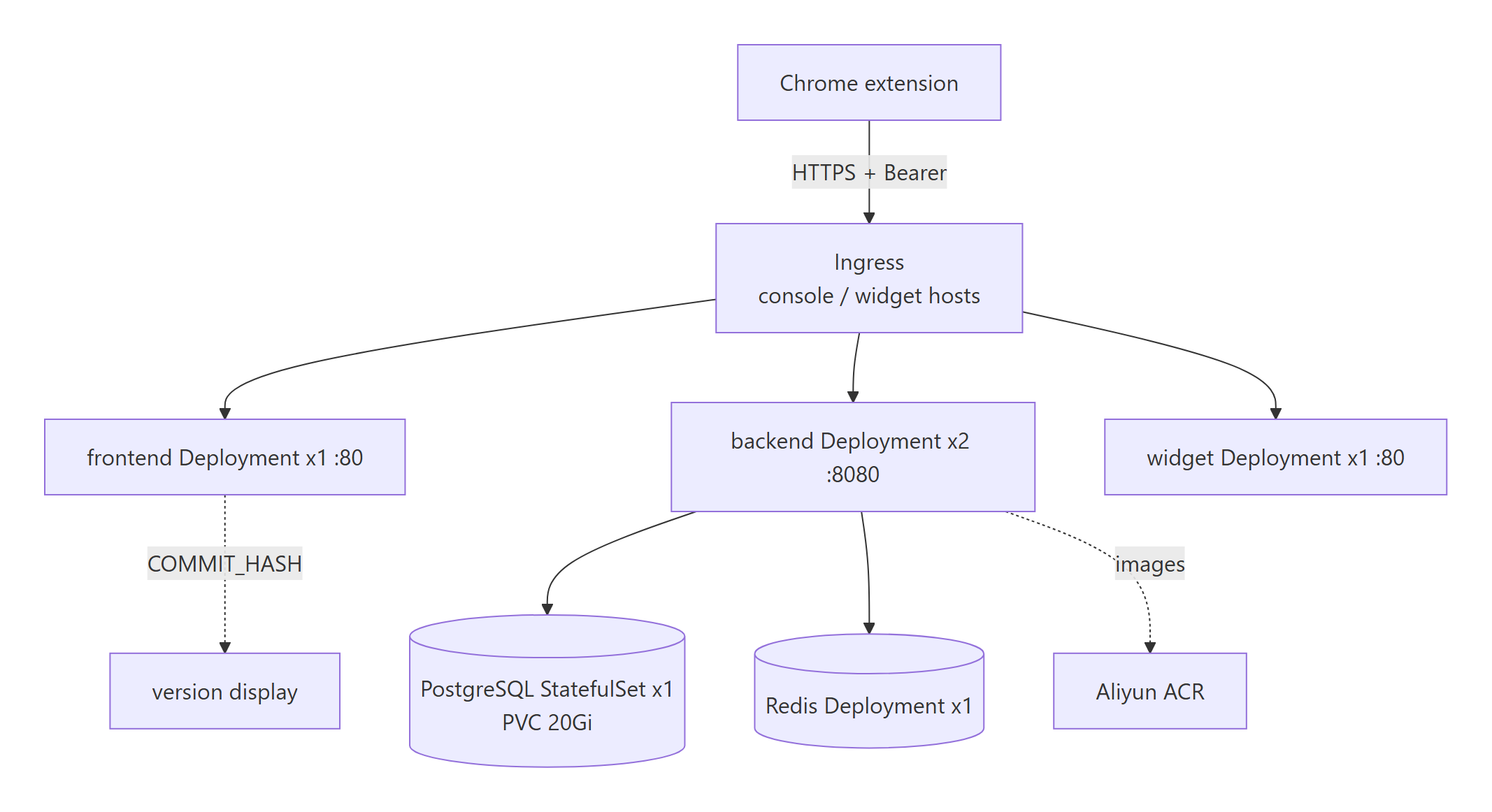
Key points:
- Two backend replicas with no session affinity: all runtime state must be persisted.
- SSE drops recover from
agent_timelineviaafterSeq. - PG and Redis are single instances;
local-pathstorage cannot drift across nodes. - Middleware images are mirrored into ACR.
3.3 Key Mechanisms
| Mechanism | Implementation | Problem solved |
|---|---|---|
| Async run | Request thread creates run and returns {runId}; execution on a virtual thread |
Long tasks never pin Tomcat threads |
| Single writer | A run is written only by the replica running it | No distributed state machine |
| Suspend / resume | Pending record + in-memory timer + cron fallback + CAS claim | No thread held; survives restart; resumes once |
| Multi-replica coordination | Redisson locks for cleanup, skill sync, pending wait, routers | Jobs never run twice |
| Tenant context | InheritableThreadLocal; background threads clear tenant/auth |
Prevents tenant bleed |
| Event decoupling | Spring local events | Breaks kernel → orchestration cycle |
| Model fault tolerance | ProviderStrategy + route fallback + backoff | Provider hiccups do not fail a batch |
| Streaming consistency | SSE deltas + persisted timeline + afterSeq |
Reconnect and multi-device consistency |
| Context watermark | HistoryLoader + compaction + tool-result compression | Prevents context blow-up |
| Channel event pipeline | Persist thread/event/delivery first; group router + agent router + worker scheduler | Webhook retries are idempotent; routing and execution are separately scalable |
| Outbound outbox | Persist-then-send, retry with backoff, idempotency key | Channel failures do not lose replies |
| IM streaming | Dedicated IM SSE stream and per-conversation read cursors | Message delivery is independent from Agent timelines |
3.4 Key Technical Decisions
| Problem | Decision | Cost |
|---|---|---|
| Tools must return quickly, but waits take minutes | wait suspends instead of sleeping |
Two wake paths + a state machine |
| “No tool called” is ambiguous | Three-branch criterion + finish + finish_reason |
Model must learn finish |
| Turn budget drifts across re-entry points | Persist loop_count and loop_limit; PINNED wins |
Extra columns and idempotent writes |
| Context blow-up | Tiered compaction + history rebuild | Compaction costs tokens |
| Logical vs hard delete | Cleanup is the only hard delete, in FK order | Delete order is hard-coded |
| Two replicas, no affinity | Persist all state; SSE catch-up | Slightly less real-time |
| Provider parameter differences | Strategy by company, no model-name guessing |
One implementation per vendor |
| Digital employee needs routing + execution | One Router instance + one Worker instance per Super Agent | Two prompts and two runtimes to maintain |
| Channel events can retry | Persist-before-route + delivery idempotency + CAS work-item claim | More scheduler tables and states |
| IM and Agent history differ | Separate IM tables and Agent timeline; link by ids | Two retention models |
3.5 Observability
| Layer | Carrier | Purpose |
|---|---|---|
| Request | TraceIdFilter + ControllerLogAspect |
Stitch one HTTP call together |
| User | agent_timeline |
User-visible execution trace; SSE catch-up source |
| Model | agent_llm_interaction_record |
Raw request/response/reasoning; prompt_tokens IS NULL AND duration_ms < 1000 = provider instant error |
| Audit | sys_audit_log + *_run tables |
Admin actions and background job trails |
| Super Agent | agent_work_item, agent_outbound_message, agent_watchdog_run |
Routing, dispatch and delivery visibility |
| IM | im_message, im_read_cursor |
Conversation delivery and read state |
Log levels: com.buukle DEBUG; *.repository and com.buukle.agent.capability WARN.
3.6 Delivery Pipeline
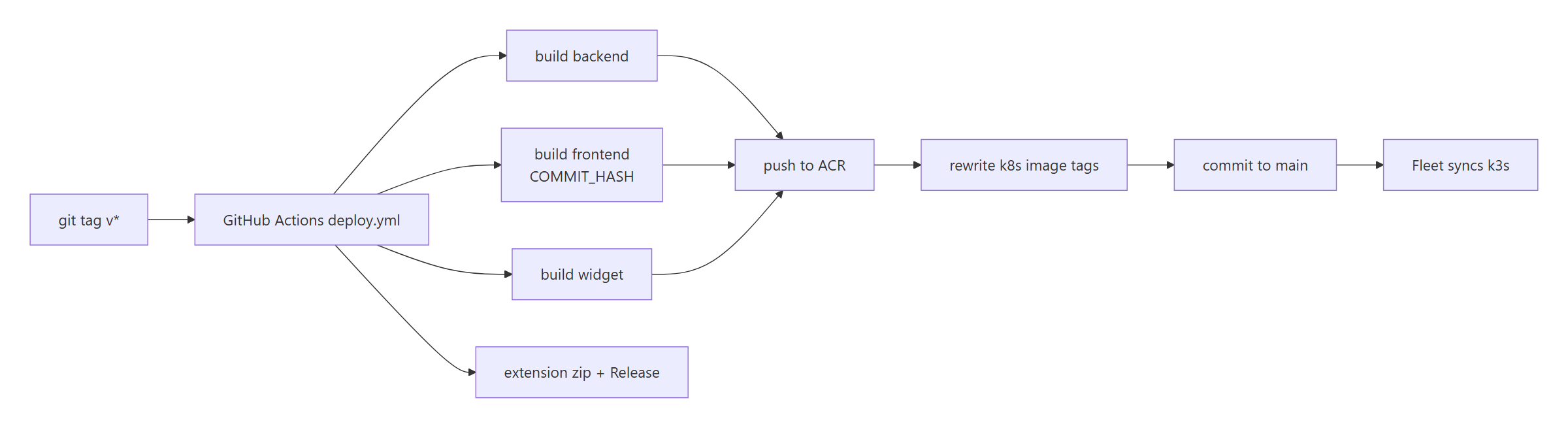
Local equivalent: .local-workflow/deploy.sh (--dry-run / --skip-existing / --only).
3.7 Technical Debt and Risks
| Item | Impact |
|---|---|
| No test CI | Regressions rely on local mvn test / biome / jest |
| Single PG instance, 20Gi local-path | No HA; growth contained by cleanup |
| SSE event cache is in-process | Cross-replica catch-up can only hit the DB |
agent_llm_interaction_record is large |
Cleanup hard-deletes; disk shrinks only after VACUUM FULL |
| Scheduled tasks not shipped | /periodic-tasks is a placeholder |
| Extension/widget not version-locked to backend | Release ordering is manual |
| Super Agent depends on several schedulers | Router / worker / outbound / watchdog must all be healthy for end-to-end delivery |
| Channel delivery is at-least-once | Consumers must tolerate duplicate replies; idempotency keys reduce but do not eliminate retries |
4. Data Architecture
4.1 Storage Split
| Store | Holds | Why |
|---|---|---|
| PostgreSQL | Business tables, timeline, raw LLM interactions, IM messages | Strong consistency, jsonb, row-level permission |
| Redis (Redisson) | Cache, locks, rate limiting, part of runtime state | Shared by replicas; must go through Redisson |
| File store | agent_file_store, documents, artifacts, screenshot fileKey |
Large objects stay out of the DB |
Browser sessionStorage |
Widget token | Cross-site embedding does not share cookies |
4.2 Data Domains
| Domain | Core tables |
|---|---|
| Agent configuration | agent_instance, agent_instance_capability |
| Session runtime | agent_session, agent_run, agent_sub_agent_run, agent_timeline, agent_tool_call_record, agent_session_todo, agent_pending_clarification, agent_pending_wait, agent_user_in_loop_record |
| Models & memory | agent_model_provider, agent_model_route, agent_api_key, agent_llm_interaction_record, agent_compact_record, agent_memory |
| Capability supply | capability_mcp, capability_skill, capability_skill_sync_run, capability_cli |
| Tasks & completions | agent_task, agent_task_artifact, agent_completions, agent_completions_call, agent_completions_prompt |
| Super Agent / channels | agent_super_agent, agent_channel_binding, agent_thread, agent_event, agent_event_delivery, agent_thread_subscription, agent_work_item, agent_outbound_message, agent_watchdog_run |
| IM | im_conversation, im_conversation_setting, im_message, im_participant, im_read_cursor |
| Platform governance | agent_user, agent_sso_identity, agent_identity_provider, sys_role, sys_permission, sys_role_permission, sys_user_role, sys_audit_log, agent_system_config, agent_session_cleanup_run |
| Content | agent_file_store, agent_document |
4.3 ER Model
The schema has only two physical foreign keys:
agent_run.session_id → agent_sessionandagent_task_artifact.task_id → agent_task. Other relations are logical*_idassociations enforced by application code.

capability_mcp / capability_cli are polymorphically bound through agent_instance_capability(capability_type, capability_id) and have no foreign key.
4.4 Data Flow
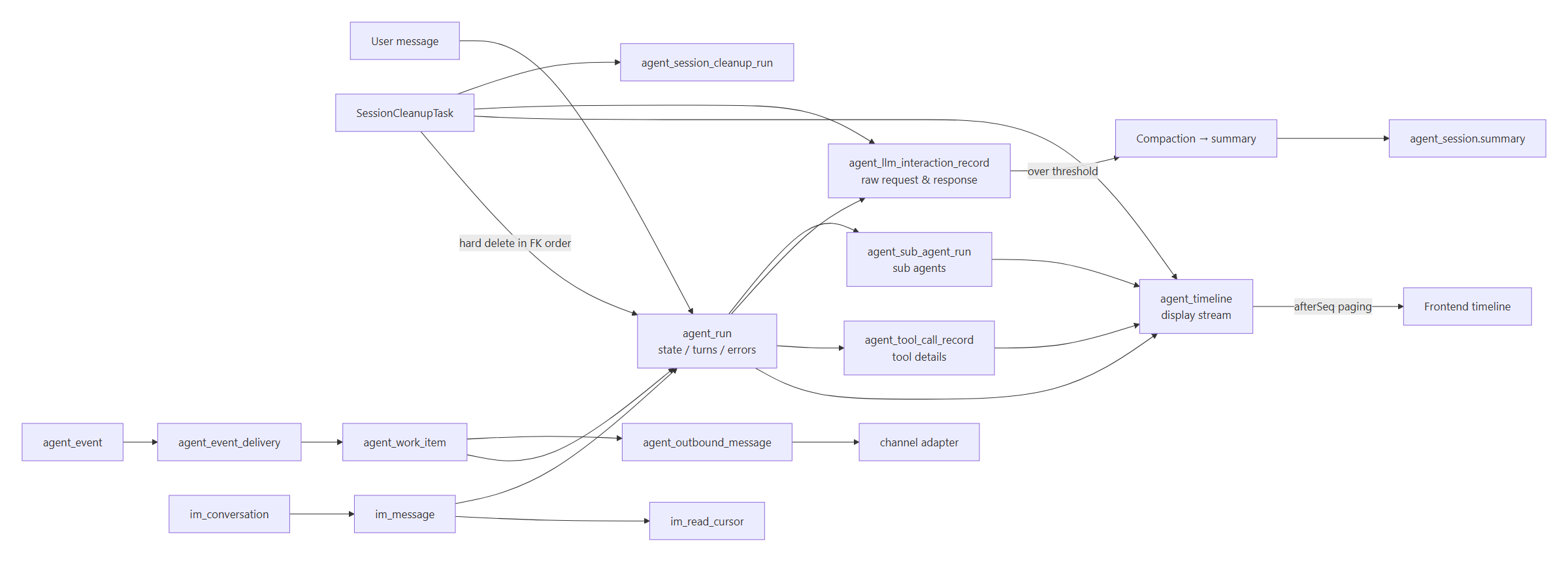
Key characteristics:
- One run writes several tables: state, display, tool details, raw LLM interaction.
- Timeline merges SSE deltas with page queries; frontend dedupes by
seq(sub-agent rows useseq < 0). - Compaction chain: history over threshold → compact record → session summary → later runs rebuild context.
- Cleanup records every round, including dry runs.
- Channel events flow through delivery → work item → run → outbound; IM messages are separate but can trigger a run.
4.5 Data Governance
| Rule | Description |
|---|---|
| Logical delete | Every table has delete_flag; session cleanup is the only hard delete |
| Common columns | status, remark, created_by, updated_by, created_at, updated_at |
| Multi-tenancy | tenant_id + created_by; row-level interceptor appends created_by to SELECTs |
| Migrations | 149 Flyway versions; applied ones immutable, additive only |
| Large tables | agent_llm_interaction_record and agent_timeline drive growth |
| Disk reclaim | Hard delete only frees space inside PG; filesystem shrinks after VACUUM FULL |
| Indexes | Cleanup relies on agent_session(delete_flag, created_at), agent_task(session_id) |
| Event idempotency | Inbound events/deliveries dedupe by source keys; work items are claimed by CAS |
| Outbox | Outbound messages persist before send; retries keep the same idempotency key |
| Retention | Super Agent threads/events/work items/outbound rows follow the retention task |
5. 4A Traceability Matrix
| Business capability | Application landing point | Data landing point | Technical means |
|---|---|---|---|
| Configure an agent | InstanceController → InstanceService |
agent_instance, agent_instance_capability |
MyBatis-Plus + row-level permission |
| Have one conversation | ChatRuntimeController → ChatRuntimeService → SessionRunner |
session / run / timeline / tool_call_record |
Virtual threads + SSE |
| Wait for a human answer | SessionRunner suspends → ChatRuntimeService.resume |
agent_pending_clarification |
CAS claim + two wake paths |
| Wait for a period of time | wait tool → PendingWaitWakeScheduler |
agent_pending_wait |
In-memory timer + cron fallback |
| Let the agent use tools | ContextPreparer.resolveTools → ToolExecutor → SPI |
capability_*, agent_tool_call_record |
Java SPI + MCP + FiberSet |
| Let the agent see/click a page | Extension → /api/v1/chrome |
agent_file_store, agent_timeline |
CDP + content script |
| Business wants structured result | TaskController → execute/extract/refine |
agent_task, agent_task_artifact |
Async polling + JSON Schema |
| Swap a model / degrade | RouteController → ModelProviderService |
agent_model_provider / route / api_key |
ProviderStrategy + fallback |
| Who may use what | @RequirePermission + AuthInterceptor |
sys_user / role / permission |
RBAC + created_by |
| Single sign-on | SsoAuthController |
agent_identity_provider, agent_sso_identity |
OIDC + PKCE + JWKS |
| Post-hoc accountability | AuditLogController, TimelineRecorder |
sys_audit_log, agent_timeline |
AOP + event funnel |
| Run a digital employee | SuperAgentController → SuperAgentService |
agent_super_agent + router/worker instances |
Router + Worker split |
| Ingest a channel message | ChannelWebhookController → EventIngestService |
agent_thread, agent_event, agent_event_delivery |
Idempotent ingest + channel SPI |
| Route work to a worker | GroupRouterScheduler → AgentRouterScheduler |
agent_work_item |
Relevance routing + CAS dispatch |
| Reply to a channel / IM | OutboundDispatchScheduler / ImMessageService |
agent_outbound_message, im_message |
Outbox + SSE |
6. Quick Start
Prerequisites: JDK 21, Maven, Node.js >= 20, PostgreSQL, Redis.
# Backend
mvn install -DskipTests
mvn -pl agent-sphere-bootstrap spring-boot:run -am

# Admin UI (:8000; proxies /api to :8080)
cd agent-sphere-ui
npm run dev

# Widget (:5173)
cd agent-sphere-copilot-widget
npm run dev
Product URLs:
http://127.0.0.1:8000/**— Agent operations platform (excluding/admin/**and/workspace)http://127.0.0.1:8000/admin/**— System administrationhttp://127.0.0.1:8000/workspace— Super Agent product
Extension: open chrome://extensions, enable Developer mode, load agent-sphere-chrome-extension/ unpacked.
Backend tests need no DB/Redis:
mvn test
7. Repository Map
agent-sphere/                  Backend (Java/Maven)
agent-sphere-ui/               Admin UI (React/Umi)
agent-sphere-copilot-widget/   Embeddable widget
agent-sphere-chrome-extension/ Chrome MV3 extension
k8s/                           k3s manifests
.github/workflows/             CI/CD
.local-workflow/               Local build/deploy scripts
examples/                      Integration examples
Project rules:
AGENTS.mdagent-sphere/AGENTS.mdagent-sphere-ui/AGENTS.mdagent-sphere-copilot-widget/AGENTS.mdagent-sphere-chrome-extension/AGENTS.md
8. Development & Verification
| Project | Verification |
|---|---|
| Backend | mvn test |
| Admin UI | npm run biome → npm run lint → npm test |
| Widget | npm run typecheck → npm test |
| Extension | vm.Script syntax check + manual smoke test |
Read the matching AGENTS.md before changing a project. It contains the mandatory rules for
magic values, enums, method size, layering, tests and runtime invariants.
License
See LICENSE.
Contact

Scan the QR code to add me on WeChat. 微信扫码添加好友。
- Email: 18001268330@163.com
- Email: zhangleielvin@gmail.com