BigMoeOnEdge

Run Mixture-of-Experts models bigger than your device's RAM. On a phone, on a PC, CPU only.



A Mixture-of-Experts model is made of many small "experts", and each generated token only uses a few of them. BigMoeOnEdge takes that literally: it keeps the small always-needed part of the model at hand and reads just the experts each token asks for, directly from flash storage, at the moment they are needed. The rest of the model stays on disk. That is what lets a model several times bigger than your RAM generate text on an ordinary phone, losslessly: the output is byte-identical to running the same model fully resident.
It is built on top of llama.cpp's public API, not as a fork. Every quantization format, tokenizer and chat template llama.cpp supports works out of the box, because llama.cpp itself is doing that part: MXFP4 and Q4_K_M stream through the same code. Supporting a new MoE architecture is one row in a registry, and following a new llama.cpp release is a routine submodule bump.
The most extreme thing it can do today: DeepSeek V4 Flash 0731, a 284B-parameter MoE (~91 GB on disk at 2-bit expert quantization), generating on a phone with 12 GB of RAM at about 1 tok/s. More than seven times more model than memory, streamed from flash as the three shard files Hugging Face ships, with no merge step and no PC in the loop.
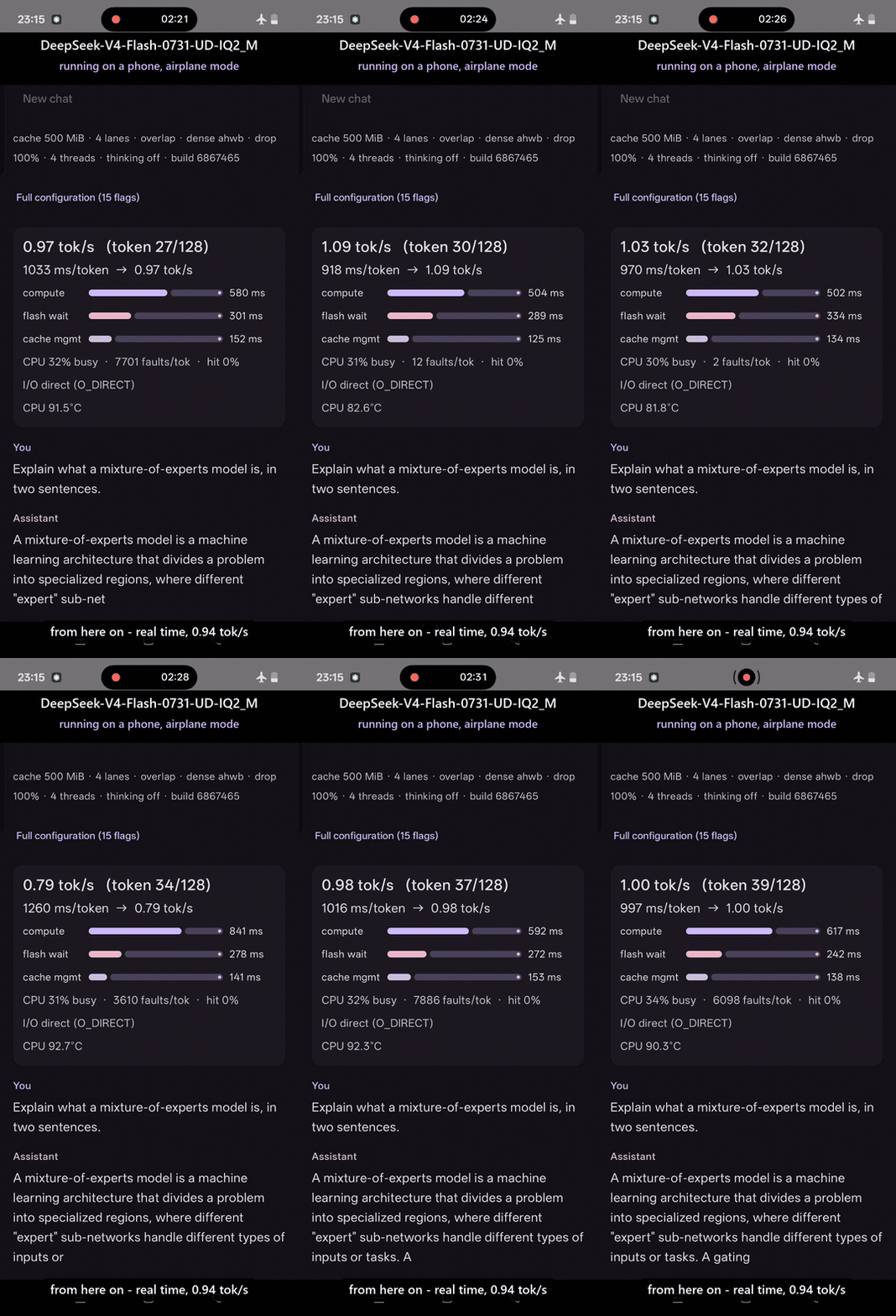
DeepSeek V4 Flash 0731: 284B parameters, ~91 GB on disk, on a 12 GB phone. 0.94 tok/s in the demo app, real time.
It is not one model, either. Below: three of them, one after another on the same phone, each past what it should be able to hold.
https://github.com/user-attachments/assets/f899b93f-c7c4-4ce9-9fb0-5ed1bae13761
Left to right: gpt-oss-120b (~60 GB), Qwen3-30B-A3B (18.5 GB), Gemma-4-26B-A4B (17 GB), recorded in the demo app on a 12 GB phone, real time, not sped up.
- Why this exists
- Try it on your phone
- Features
- Supported models
- Benchmarks
- Quickstart
- How it works
- Documentation
- Prior art
- License
Why this exists
The models people actually want to talk to keep growing faster than the RAM in the devices they carry. MoE models offer a way out, because most of their weights sit idle on any given token, but every mainstream runtime still insists on holding (or paging) the whole file in memory. So a 20 GB model on a 12 GB phone either refuses to load or crawls while the OS frantically swaps.
BigMoeOnEdge treats flash storage as part of the memory hierarchy instead. Three situations where that changes what your device can run:
Models far past RAM. A ~60 GB model on a 12 GB phone cannot be resident, full stop. Streamed, it runs at usable speed. This is the headline case, but it is not the only one.
Models just past RAM. An 18 to 22 GB model on a 12 GB phone is where the ordinary way of loading (mmap) turns into a fault storm: the OS evicts weights as fast as it reads them, speed swings wildly, other apps get killed. Streamed, the same model runs stably at up to 5 tok/s, byte-identical output, and the rest of the phone stays alive.
Models that barely fit. Even a model that technically fits in RAM, say an 8B class MoE on a phone with a few GB free, benefits: loaded the ordinary way it squeezes out everything else, and the OS claws memory back mid-generation. Streamed with a capped cache, it runs inside a budget you choose and leaves the system alone. And this is all plain CPU inference: no GPU, no NPU, four cores and the phone's flash storage.
The same engine builds unmodified on desktop, where a model past RAM streams from the SSD out of the box. Phones stay the focus, because that is where memory is tightest.
Try it on your phone
No build needed. Install the APK from the
latest release, open the Get a
model card, and tap one of the catalog entries: Qwen3-30B-A3B (18.6 GB), Qwen3.6-35B-A3B
(22.3 GB) or Gemma-4-26B-A4B (~17 GB), each past most phones' RAM. The catalog is only a
shortcut: the downloader takes any direct gguf URL, so any model from the
supported architecture families streams the same way. When the download
finishes, pick the model and chat. The telemetry panel shows tok/s and the compute-vs-flash
split live, and every streaming knob below is in Settings.
Models above Hugging Face's 50 GB per-file limit (gpt-oss-120b, DeepSeek V4 Flash 0731) ship as
multi-shard ggufs, and both are in the catalog: the app fetches the shards one after another,
resumable, under a single progress bar. The engine reads a split set natively, so there is no merge
step anywhere. Outside the catalog the rule is the same: put the shards in one directory and point
at the first (-00001-of-...).
Features
Grouped the way the demo app groups them in Settings. Each row is one setting: the name the app uses, the flag it maps to, and what it does. The app folds the experimental ones into a collapsed group; here they are marked.
Streaming itself is the engine (--moe-stream): only the experts a token routes to are read, from
flash, at the moment they are needed. Everything below tunes that.
Streaming
| Setting | Flag and values | What it does |
|---|---|---|
| Expert cache | --cache-mb auto, 0, 500 to 6000 MiB (app default 2000) |
Keeps the most-used experts in RAM. auto sizes it once at load from free memory; a fixed value is reproducible, which is why the app ships one. Below the engine's floor it only churns. |
| Cache ceiling | --cache-ceil-mb 0 (no cap), 2000 to 6000 |
Caps what auto may claim. The OS counts our own mapped weights as free, so uncapped it can ask for more than exists. |
| Parallel I/O lanes | --io-threads 1, 2, 4, 8 (default 4) |
Reads several expert slices at once. Helps until the flash saturates, which this engine's own measurements put at two lanes on the test device. |
| Direct I/O | --no-odirect disables it (on by default) |
Bypasses the OS page cache, so the system holds no second copy of what the expert cache already has. Falls back where unsupported. |
| I/O and compute overlap | --overlap (off in the CLI, on in the app) |
Issues the next reads while the current layer computes, hiding flash latency behind work. Byte-identical; needs a small optional add-on to llama.cpp (seam). |
| Dense weights | --dense-weights mmap, warm, anon, ahwb (default anon) |
How the always-needed non-expert weights are held. Decisive far past RAM. ahwb is Android-only and puts them where the kernel cannot reclaim them at all (data). |
| Temporal prefetch (experimental) | --prefetch 0 (off), 1, 2, 4 layers |
Bets a layer reuses the previous token's experts and fetches them on idle lanes. Needs the cache. |
| Predictive prefetch (experimental) | --predict-prefetch, with --predict-spec-max 0 (retention only), 1, 2, 4 |
Runs the next layer's own router early and fetches what it names. More accurate than the bet above; reading ahead on it still lost its on-device A/B (why). |
Speed and quality
| Setting | Flag and values | What it does |
|---|---|---|
| Drop cold experts | --drop-cold-experts 0 (off) to 1.0; app rungs 50%, 75%, 100% (app default 75%) |
Skips a routed expert only when it is a cache miss and the router wanted it less than that share of an even split. Quality is spent only where it buys a read. Lossy and not reproducible: what is skipped depends on what the cache held. |
| Active experts | --n-expert-used 0 (model's own), 6, 4, 3, 2 |
Consults fewer experts per token than the model asks for, cutting compute and reads together. Lossy, but reproducible: the same prompt gives the same answer. |
| Guess ahead (experimental) | --mtp or --ngram, with --draft 1 to 5 and, for the head, --mtp-p-min 0, 40%, 60%, 80% |
Drafts the next few tokens and verifies the group in one decode, keeping only what the model itself would have produced. Nothing is approximated. Wins when weights move once per group, loses when the wider verify widens each layer's read set (mtp, ngram). |
| Route-ahead (experimental) | --route-ahead 0 (off), 1, 2, 4 layers |
Commits a layer's routing that many layers early, so its reads start early and can never be wasted. Lossy: some slots route differently. Excludes both prefetchers and Guess ahead (detail). |
Everything under Streaming changes how weights are fetched, never the math, so the answer is the one the model would have given anyway. The settings in this section are different in kind: they change what the model computes, and they are here because on a device far past its memory the alternative is often not a slower answer but no answer at all.
They are not interchangeable. Reducing the active experts cuts the routing tail whether or not those experts were already free to run from memory, and it does so identically every time. Dropping cold experts spends quality only where it buys back a flash read, which is more surgical but makes the answer depend on what the cache happened to hold, so the same prompt can come out differently. Guessing ahead gives up nothing at all: it changes how many tokens a pass confirms, not what the model computes.
Each one is measured rather than assumed, and the numbers live with the method that produced them: expert-dropping.md, mtp.md, ngram.md, route-ahead.md. Judge any of them on your own task before relying on it.
Sessions and telemetry
The model stays loaded across chat turns, and every run can account for its own time: --progress
breaks each token into flash I/O, cache management and compute, next to the cache hit rate and
bytes read, and --csv adds the memory picture those numbers must be read against. The Android
app renders the same feed live while you chat. More under Telemetry.
Android demo app
examples/android is a small chat app over the same engine: model downloader,
live telemetry panel, and every knob above in Settings with a one-line note on what it does.
Defaults are the measured winning recipe for a model near RAM.
Supported models
| Architecture | Reference models | Notes |
|---|---|---|
qwen3moe |
Qwen3-30B-A3B and siblings | Shipped default, validated below |
qwen35moe |
Qwen3.6-35B-A3B and siblings | Hybrid attention/SSM stack; routed experts stream unchanged |
qwen2moe |
Qwen2 MoE family | Same layout as qwen3moe |
gemma4 |
Gemma 4 MoE (e.g. 26B-A4B) | Fused expert layout, handled by its registry row |
gpt-oss |
OpenAI gpt-oss-20b / 120b | Purely routed; MXFP4 weights stream unchanged |
lfm2moe |
Liquid AI LFM2 / LFM2.5 MoE (e.g. 8B-A1B) | Hybrid conv/attention stack with leading dense blocks; those stay resident |
deepseek4 |
DeepSeek V4 Flash (284B-A13B), validated on the 0731 release | V3.2-style routing (256 experts + shared); compressed attention is dense-side; ships multi-shard |
Adding an architecture is one row in the registry; expert counts and layouts are discovered from
the model file at runtime, so nothing about a specific model is hardcoded in the streaming path.
Procedure: docs/adding-a-model.md. bmoe-cli --list-archs prints the
compiled-in set.
Benchmarks
All figures are measured, not modelled; all models are Q4_K_M.
About the numbers. Measured on one device (12 GB RAM, 11.3 GB usable, UFS 4.x storage) over
adb shell, 256-token greedy decode. Each number is the best observed for that configuration, and rows in a table can come from different benchmark sessions. Phone throughput moves a lot with device state (heat, free memory), so the same command can read lower. Full method and distributions: docs/benchmarks.md.
How to read the tables. Each row is one configuration of the same model on the same phone.
mmap baseline is the same file loaded the ordinary way (no streaming), which is what the
streamed rows are compared against. k is how many experts each token routes to, i.e.
n_expert_used (set with --n-expert-used); each table shows the model's default width and,
where measured, a reduced k, the measured lossy setting. Flash/token is data read from storage
per generated token (lower means the cache is working) and cache hit is the share of expert
reads served from RAM instead of flash. Bold marks the best configuration for that model.
gpt-oss-120b (Q4_K_M): ~60 GB on a 12 GB phone
| Setup | Active experts | Cache | Lanes | tok/s | Flash/token | Cache hit |
|---|---|---|---|---|---|---|
| mmap baseline | 4 | n/a | n/a | 0.09 | n/a | n/a |
| streamed | 4 | off | 4 | 0.7 | 1817 MiB | n/a |
| streamed | 4 | 2000 MiB | 8 | 1.3 | 1292 MiB | 27% |
| streamed | 2 | off | 4 | 1.8 | 909 MiB | n/a |
| streamed | 2 | 2000 MiB | 8 | 2.2 | 590 MiB | 32% |
All streamed rows use --overlap --dense-weights anon --no-think. The setting that unlocked this
model is --dense-weights anon: this far past RAM the phone keeps reclaiming the always-used
weights mid-generation, and moving them out of the page cache was worth 3.2× by itself. Note
that --no-think disables the model's reasoning and costs quality at k=4; the full matrix and
quality notes are in docs/benchmarks-gpt-oss.md.
Qwen3.6-35B-A3B (Q4_K_M): 22.3 GB
A hybrid attention/SSM MoE (256 experts, top-8, 41 blocks): most layers are linear attention
(Gated Delta Net) rather than full attention, and the routed experts stream exactly like a plain
qwen3moe. At ~2× device RAM the mmap baseline collapses into a fault storm; streaming with the
dense weights kept out of the page cache (--dense-weights anon) runs it stably.
| Setup | Active experts | Cache | Lanes | tok/s | Flash/token | Cache hit |
|---|---|---|---|---|---|---|
| mmap baseline | 8 | n/a | n/a | 0.1 unstable | n/a | n/a |
| streamed | 8 | 2000 MiB | 4 | 4.3 | 206 MiB | 56% |
| streamed | 8 | 3000 MiB | 4 | 5.0 | 144 MiB | 65% |
| streamed | 6 | 2000 MiB | 4 | 5.4 | 137 MiB | 60% |
| streamed | 6 | 3000 MiB | 4 | 5.8 | 91 MiB | 68% |
All streamed rows use --overlap --dense-weights anon. A larger cache is the main lossless lever
(cache 3000 is worth +16% over 2000); the k=6 rows are the measured lossy option (turbo top-k, below),
worth a further ~16% by routing to six experts instead of eight. The lossless best here is cache
3000 at the model's own width, 5.0 tok/s, output byte-identical to the resident model.
Unlike the tables above, these Qwen3.6 figures are a single 96-token run rather than the 256-token best-of protocol: treat them as indicative, and not strictly comparable to the other models until re-measured under the full protocol.
Qwen3-30B-A3B (Q4_K_M): 18.5 GB
| Setup | Active experts | Cache | Lanes | tok/s | Flash/token | Cache hit |
|---|---|---|---|---|---|---|
| streamed | 8 | off | 4 | 1.7 | 1051 MiB | n/a |
| mmap baseline | 8 | n/a | n/a | 2.0 unstable | n/a | n/a |
| streamed | 8 | 2000 MiB | 4 | 2.4 | 480 MiB | 53% |
| streamed | 8 | 4000 MiB | 4 | 4.0 | 225 MiB | 76% |
| streamed | 6 | 4000 MiB | 4 | 5.0 | 165 MiB | 77% |
| streamed | 8 | auto, cap 4000 | 4 | 5.2 | 225 MiB | 76% |
Cache size is the dominant lever here, and the auto-sized cache with a ceiling (docs/cache-sizing.md) is the winning recipe. The mmap baseline averages ~2 tok/s but swings wildly token to token and evicts other apps. Turbo top-k (k=6) trades a little quality for a further +24% over the model's own width.
Gemma-4-26B-A4B (Q4_K_M): 17.0 GB
| Setup | Active experts | Cache | Lanes | tok/s | Flash/token | Cache hit |
|---|---|---|---|---|---|---|
| mmap baseline | 8 | n/a | n/a | 0.4 | n/a | n/a |
| streamed | 8 | off | 4 | 1.6 | 904 MiB | n/a |
| streamed | 8 | 2000 MiB | 4 | 2.2 | 366 MiB | 58% |
| streamed, overlap | 8 | 2000 MiB | 4 | 2.8 | 365 MiB | 58% |
| streamed | 8 | 4000 MiB | 4 | 4.1 | 144 MiB | 82% |
| streamed | 6 | 4000 MiB | 4 | 5.0 | 98 MiB | 83% |
Gemma keeps more of itself permanently resident, so the 4000 MiB cache fits only when enough RAM is free at launch; cache 2000 + overlap is the dependable everyday setting on this device. Turbo top-k (k=6) is the fastest here (+22%) but changes the output.
What to expect in the app
The tables above are a benchmark protocol over adb, not a chat session. The demo app lands close:
the best gpt-oss config reads 1.9 tok/s in the app against 2.2 over adb, about 13% below. The
gap is the protocol (short chat replies never fully warm the cache), not the app. The app's
telemetry panel reports the same fields as the CLI, so you can see it directly. Analysis:
docs/warmup-analysis.md.
Desktop
Not the primary target, for now. The engine builds and runs unmodified on desktop and a model past RAM streams from the SSD out of the box, but the tuning, the defaults and the measurement protocol are all aimed at phones, because that is where memory is tightest and where the problem this engine exists for actually bites. What follows is a snapshot, not a tuned configuration.
Measured on a Windows x86 laptop (8 cores, 16 GB RAM, dual-channel DDR4, NVMe SSD) with Qwen3.6-35B-A3B at ~1.5× RAM, 256-token generations:
| Setup | Active experts | Cache | Lanes | tok/s | Flash/token | Cache hit |
|---|---|---|---|---|---|---|
| streamed | 8 | auto | 4 | 4.8 | 74 MiB | 84% |
| streamed, drop 75% | 8 | auto | 4 | 6.8 | 23 MiB | 92% |
| streamed, overlap, drop 75% | 8 | auto | 4 | 7.3 | 24 MiB | 92% |
The interesting part is that the bottleneck flips: on the phone streamed decode is I/O-bound,
on this laptop it is DRAM-bandwidth-bound in compute (~0.11 s/token in every cell, so a ~9 tok/s
ceiling even at zero I/O). More io lanes, more compute threads and the ~3 GB/s NVMe are all
neutral; the levers that pay are the cache budget, cache-aware dropping and --overlap. Full
campaign, including the cache-auto confound that round 1 had to unwind:
docs/bench-data/2026-07-24-desktop-qwen36.
If the model fits in RAM, just run it resident.
How this is tested, and where the numbers come from
Three kinds of evidence, kept apart on purpose: correctness is asserted, speed and quality are measured, and neither is allowed to stand in for the other.
Correctness is a gate, not a benchmark. ctest runs byte-identity gates on a tiny synthetic MoE
model generated by scripts/make-tiny-moe.py: streaming only the routed
experts must produce output identical to running with every expert resident, and the same holds
across the LRU cache, evictions, the --overlap async path, temporal and predictive prefetch, the
dense-weight rebind, multi-turn sessions, and a split multi-shard model read across shard
boundaries. A lossy knob gets gates for its machinery
instead: that changing
where the engine loads did not itself change a byte, which is what separates "the plumbing is
correct" from "the setting is lossy".
Speed is measured on device, over adb shell or in the demo app, one variable at a time, with
the raw per-token CSVs committed under docs/bench-data/ next to a findings.md
that states the caveats: run order, thermal state, and what the cell does not show. Confidence
intervals are bootstrapped over the per-token series rather than quoted from a single mean. Method:
docs/benchmark-method.md.
Quality, for the lossy settings, is checked against a public benchmark. The cache-aware dropping check uses 15 questions taken verbatim from the GSM8K test split (openai/grade-school-math, MIT), with the grading rule fixed before any output was read and every reply committed so the grading can be audited. Decoding is greedy throughout, so there is no sampling noise: a difference between two cells is caused by the setting, not by chance. At that sample size such a check rules out a collapse, not a subtle cost, and the write-ups say so.
Anything not measured is named as unmeasured. That is the rule the roadmap's recorded negative results exist to enforce: a simulation that predicted a win and a device that then delivered a 30% loss is why nothing here is published on an argument alone.
Quickstart
Host (Linux, macOS, Windows)
git clone --recursive https://github.com/Helldez/BigMoeOnEdge.git
cd BigMoeOnEdge
scripts/build-host.sh

# stream a MoE model with a device-sized expert cache and 4 read lanes
build/cli/bmoe-cli -m Qwen3-30B-A3B-Q4_K_M.gguf --moe-stream \
  --cache-mb auto --cache-ceil-mb 4000 --io-threads 4 -t 4 -n 48 \
  --chatml -p "Explain MoE routing."
For a model several × device RAM, the shape that produced the gpt-oss numbers is:
build/cli/bmoe-cli -m gpt-oss-120b-Q4_K_M.gguf --moe-stream --overlap \
  --dense-weights anon --cache-mb 2000 --io-threads 8 -t 4 -n 256 \
  --chatml --no-think -p "Explain MoE routing."
The model must live on a real filesystem (on Android /data/local/tmp/..., not /sdcard). Omit
--moe-stream for the plain mmap baseline. The byte-identity gates (streamed == resident) run with
cd build && ctest --output-on-failure (needs python3 with the gguf package).
Platform status: Linux is exercised by CI (build + gates) and Windows is where the
desktop numbers were measured. On Windows, build with CMake directly (Visual Studio
Build Tools); the script above is bash, and MSVC puts the binary in build\cli\Release\bmoe-cli.exe.
macOS builds from the same sources (the platform branches exist) but is not validated, and it has
no O_DIRECT, so direct reads fall back to buffered I/O there.
Android
The demo app is in examples/android: build the CLI for arm64 with
scripts/build-android.ps1, build the APK, push a model. Settings expose every streaming knob with
a one-line note on what it does; defaults are the measured winning recipe for a model near RAM. For
a model several × RAM, switch the dense-weights policy to anon and give the cache a real budget.
A prebuilt debug APK is attached to each
release.
How it works
The model loads file-backed, and the engine hooks llama.cpp's public evaluation callback. When a
layer picks its experts for the current token, the engine fetches exactly those slices from flash
just in time for the matmul, optionally caching the hottest ones and overlapping reads with
compute. No llama.cpp sources are modified. The one exception is the optional --overlap flag,
which needs a per-expert wait point inside the CPU MoE kernel that no public API exposes: it
carries a single ~25-line hook, as one commit on the fork branch bmoe/expert-ready-hook. The
hook is zero-cost when unregistered, everything else builds against stock upstream, and it is
dropped the moment upstream ships an equivalent. Design and the exact API contract:
docs/architecture.md, docs/seam.md.
Telemetry
A model streamed past RAM fails in ways that all look identical from outside: it's just slow. So
every run accounts for its own time. --progress breaks each token down into flash I/O, cache
management and compute, next to the cache hit rate and the bytes read; --csv adds the memory
picture those numbers have to be read against. The Android app renders the same feed live while you
chat, which is how you watch a phone quietly take its memory back mid-answer.
What makes it worth reading is that the engine is candid about its own numbers. Compute, in particular, isn't measured: it's whatever time is left once the measured parts come out, so it silently absorbs page faults and throttled cores. Rather than let that pass, the engine ships the counters that pull the residual apart, and marks anything it couldn't measure as unmeasured instead of quietly reporting zero. That candour extends to the headline: tok/s times the decode and nothing else, so the sampling, detokenizing and rendering between one token and the next fall outside it; the engine reports that time too, rather than letting work hide in the gap.
Every metrics file also states the run that produced it: the engine version and the full resolved configuration, including whether the run was instrumented or sampled, because such a run is not a benchmark run. Two files put side by side answer "which is faster" only if something says what differed between them, and by the time a file is read the command line that made it is long gone.
When the per-token split isn't enough, two diagnostics go further: one records what the router asked for on every token, the other times the compute graph node by node. Both perturb the run they measure, and both say so.
Formats and schemas: docs/telemetry.md.
Documentation
docs/ is indexed by what you're trying to do: understand the design, extend it, or reproduce the measurements. Most-wanted entry points:
- docs/architecture.md: the layer map and the llama.cpp relationship.
- docs/adding-a-model.md: supporting a new MoE architecture.
- docs/benchmarks.md: measured results and how they were produced.
- docs/telemetry.md: the per-token line protocol, the CSV schema and the traces.
- docs/android-memory.md: what reclaims the engine's memory on a phone.
Prior art
This is an engineering package of ideas from AirLLM, Apple's LLM in a flash, FlexGen, PowerInfer and EdgeMoE, not a novel technique. The closest recent work is flash-moe: a purpose-built Metal engine that streams a 397B MoE from SSD on Apple Silicon, and on an iPhone through a community fork. BigMoeOnEdge takes the other side of that problem: CPU-only, on Android, on llama.cpp's public API (bar one optional ~25-line hook, above), across architectures. See docs/limitations.md.
License
Apache-2.0. See LICENSE.